
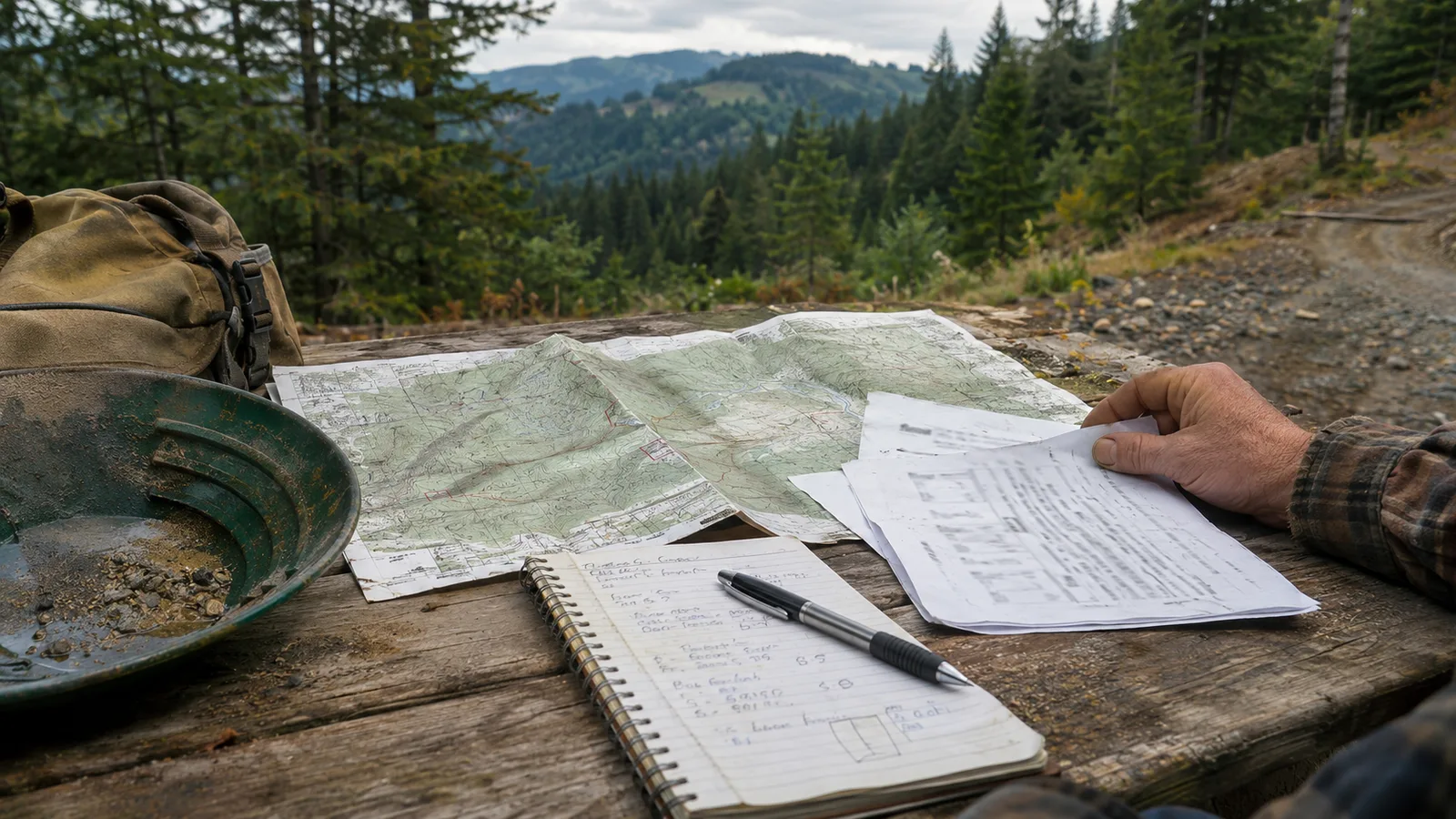
Look through mining claims for sale and you will find listings like this one: a gold claim for several thousand dollars. It mentions a BLM serial number, a historic district and maybe a sluice box left on site. Before any money moves, you need to know what the seller actually holds, whether the records back it up, and what you would be taking on.
Buying a mining claim usually means buying a seller's interest in an unpatented federal claim. You are buying a limited right to explore for and develop minerals on public land, and the land itself stays federal. An ad, an open BLM record or a famous gold district tells you very little on its own. None of them establishes that the claim is legally valid, economically worth mining, reachable, or worth the asking price.
Federal regulation says so directly: recording a claim, filing documents or paying fees does not make a claim valid if it isn't otherwise valid under the law. BLM's own buyer brochure is blunter. It tells people buying online to keep "buyer beware" in mind, and warns that sellers may give incomplete or incorrect information and may not disclose residual hazardous materials.
The ten checks below follow the order a careful buyer would work through them, cheapest first. Most of the early ones cost nothing and can kill a bad deal in an afternoon.
This guide focuses on unpatented federal claims. Buying an existing claim is also a different job from locating a new one on open ground: a buyer inherits someone else's paperwork, history and problems.
Where to verify each item
| What to verify | Where to check | Warning signs |
|---|---|---|
| What is being sold | Purchase agreement, draft deed | "Land for sale," "your own private creek," cabin included |
| Serial number and claim type | BLM MLRS reports | Seller won't give the serial, or only offers a claim name |
| Who holds the interest | MLRS Serial Register Page, county recorder | Seller's name absent, multiple claimants, a gap in the deed chain |
| Status | MLRS case disposition | Closed, Under Review, On Appeal, or a status the seller can't explain |
| Fees and filings | MLRS case actions, Serial Register Page | No fee or waiver for the current assessment year |
| Location and boundaries | County location notice, BLM map, the ground | Paper and map disagree, no monuments, overlapping claims |
| Mineral evidence | Assay certificates, sample maps, your own sampling | Only historic production stories, "assays available after purchase" |
| Access and restrictions | BLM or Forest Service local office, county road records | Access crosses private land, withdrawal on the map |
| Liabilities | Local agency files, site visit | Open workings, old fuel or chemicals, an unreclaimed operation |
| Transfer mechanics | State law, county recorder, BLM State Office | Pressure to pay before any deed exists |
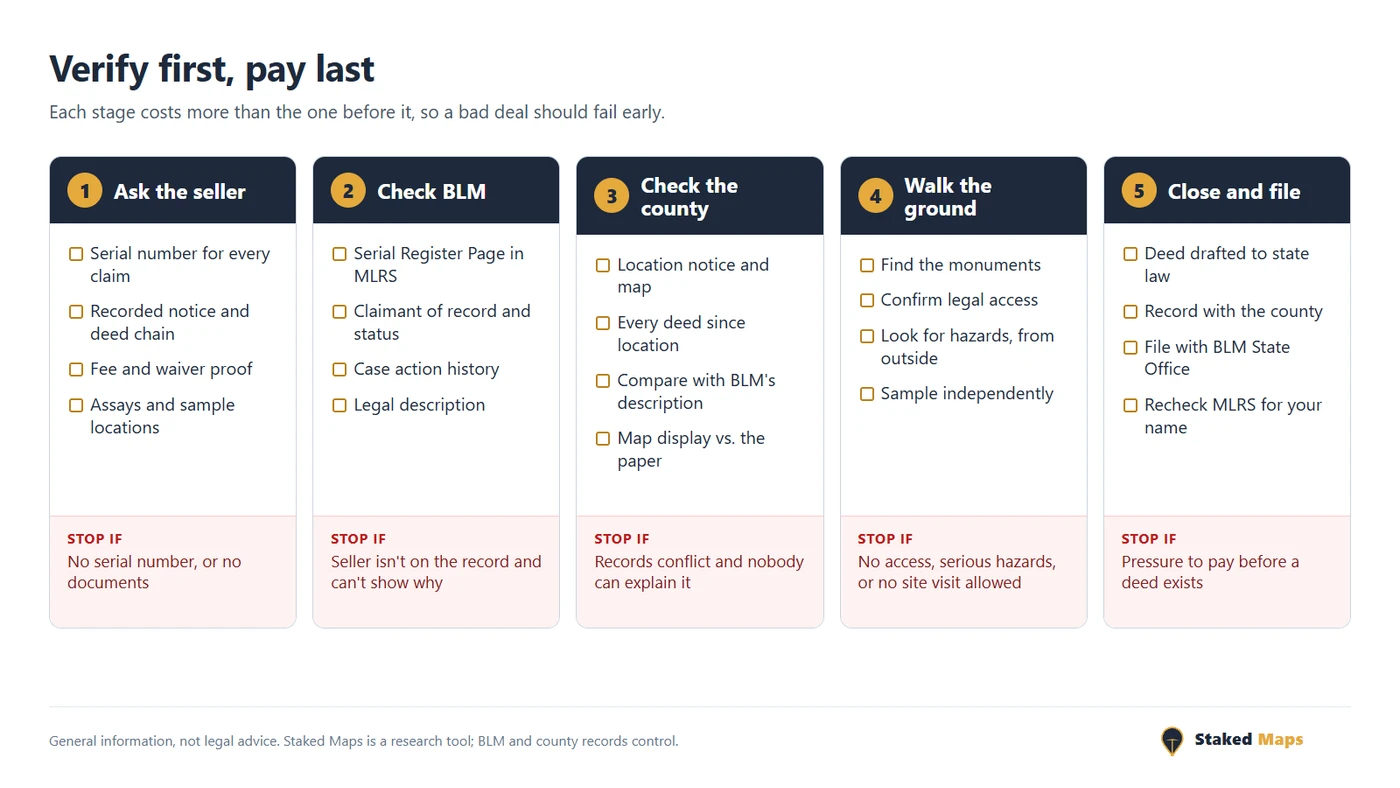
The ten checks
1. Pin down exactly what is being sold
Ask the seller to state in writing whether the sale covers an unpatented claim, a patented claim, private land, a lease, shares in a company, equipment, or some combination. Each is a different asset.
An unpatented claim is a real but limited property interest. BLM describes the buyer's right as restricted to exploration, development and extraction of a mineral deposit, with the surface of almost all such claims remaining under United States ownership and management. You can't keep the public out, and a claim doesn't give you a place to live.
A patented claim is private land, and that purchase runs like a real estate deal with a title search. Our guide to mineral rights and mining claims explains those differences. If an ad promises a homesite, read whether you can build a cabin on a mining claim before going further.
2. Get the BLM serial number and run it yourself
The seller should provide an official BLM serial number and proof of recording with both the county and BLM. A current serial number is usually a state prefix followed by nine digits. Older paperwork may show a legacy number.
Look it up in BLM's Mineral & Land Records System reports rather than trusting a printout. The Serial Register Page is the single most useful report. Confirm that the claim name, type (lode or placer), county and legal description all match what the seller told you.
If the seller can't or won't supply a serial number for a federal claim, stop there. BLM states that claims not recorded with it give you no rights to federal minerals.
Alaska needs a separate check. State of Alaska claims sit on state land and are tracked by the Department of Natural Resources under an ADL number. Alaska publishes its own Buyer Beware notice for them.
3. Confirm who actually holds the claim
Compare the seller's legal name, exactly, with the claimants on the Serial Register Page, then trace the chain of deeds at the county recorder from the original location notice to today.
BLM's reports carry Privacy Act redactions, and BLM offers unredacted access through a Login.gov account. If a name you need is hidden, create that account or call the BLM State Office.
Three situations cause most of the trouble:
- Co-claimants. One person selling "the claim" may hold only a share. Alaska's notice warns that you may not end up being the only owner of record, and the same logic applies to federal claims.
- Unfiled transfers. A deed can exist at the county that never reached BLM, or the reverse. Under federal rules, a county recording alone doesn't get a new owner recognized by BLM. Your seller may be several deeds away from the name on BLM's record.
- Estates and companies. If the claimant died or is a business, ask for the document giving this person authority to sign.
4. Read the status, then look past it
Pull the case disposition from MLRS and learn what it means. Active is only one of several values. Filed, Under Review and others also belong to claims still on the books, and Closed means the claim is no longer in force in BLM's records. Our guide to BLM mining claim statuses defines each one.
Active, Filed and Under Review are administrative dispositions, and they don't mean the same thing. None of them is a finding that the claim is valid or would survive a challenge. The government can examine a claim at any time to determine whether valid rights exist. A claim can also be invalid from the start if it was located on land closed to mineral entry, and BLM warns that any money paid to a private seller in that case is a civil matter between you and the seller.
5. Review the fee and filing history
Maintenance is due every year by September 1: $200 per lode claim, and $200 for each 20 acres or portion of a placer claim. Missing it generally forfeits the claim. See how long a mining claim lasts for how that cycle works.
Check the case actions for each recent assessment year. You want either a fee payment or an accepted small miner waiver, plus any affidavit of assessment work that the waiver required.
Watch for a waiver. A claimant holding 10 or fewer claims nationwide can file a waiver in place of the fee, but the seller's eligibility doesn't transfer to you. BLM's Oregon/Washington office explains that the new owner must also qualify, counting all their associated claims, or pay the fee by the September 1 after the transfer takes effect.
Watch the calendar. A sale closing in July or August can leave it unclear who owes the upcoming September 1 payment. Put the answer in the purchase agreement, then confirm in MLRS afterward that the payment posted.
6. Confirm the location and boundaries
Get the county-recorded location notice and its map, and compare them with BLM's legal description, then with the ground.
Federal claims are described by the Public Land Survey System, usually down to a quarter-quarter section or finer. Mapped claim shapes, including BLM's and those in Staked Maps, are generally built from those descriptions. They are approximate and can't stand in for a survey.
Walk it if the deal is still alive. BLM says claims require corner monuments and a discovery monument, subject to state requirements, while acknowledging that some claims have paperwork and no monuments on the ground. Overlaps matter too: BLM doesn't notify claimants or refund money over boundary conflicts and treats them as civil matters. A placer buyer should also check claim size, since an individual placer claim is limited to 20 acres and an association to 160.
7. Separate mineral evidence from sales talk
Historic production nearby tells you people once found gold in the neighborhood. It doesn't show that gold remains inside these boundaries in recoverable amounts. A legally valid claim needs a discovery on that claim, physically exposed within its boundaries. Under the prudent man rule and marketability test, the deposit must justify further investment and offer a reasonable prospect of profit. BLM's discovery rules for placer claims also call for showing each 10 acres to be mineral in character.
Treat evidence in this order, weakest first:
| Evidence | What it can tell you | What it can't tell you |
|---|---|---|
| Historic district or nearby mine | Gold occurred in the region | Anything about this claim |
| USGS or state mineral occurrence record | A mineral was reported near a point | Grade, quantity, current access |
| Old claims in the same section | People thought the ground was worth staking | That they profited |
| Seller's photos of gold | Someone recovered gold somewhere | Where it came from, how much work it took |
| Assay certificate | Metal content of one sample | Whether that sample represents the claim |
| Mapped, repeatable sampling you controlled | What this ground actually carries | Long-term economics |
Ask where each sample came from, who took it, and which lab ran it. For a meaningful price, pay someone independent to sample before you close. The USGS Mineral Resources Data System is a good free starting point, but it's only that.
8. Check access, surface management and restrictions
Find out who manages the surface, then call that office. BLM recommends contacting the local BLM or Forest Service office with jurisdiction before you begin. Ask specifically about:
- Legal access. A road on a map may cross private land or be closed to vehicles. Being able to see a claim from a road gives you no right to drive to it.
- What operations are allowed. Whether you need to file anything depends on the type, extent and location of the work. On BLM land, 43 CFR 3809 sorts operations into casual use, notice-level work and plans of operations. On National Forest land, 36 CFR 228 Part A applies. Describe your intended equipment and disturbance to the local office and ask what it would require.
- Withdrawals. Land withdrawn from mineral entry can hold only claims with valid existing rights from before the withdrawal, and proving those rights can be costly.
- Occupancy. Staying more than 14 days in a 90-day period requires approved, active mining work. Buildings, roads and fences need agency authorization first.
- Water. A placer operation needs water, and a claim doesn't automatically bring a water right with it. Ask your state's water agency what applies, and ask the seller for documentation if a right is being claimed.
Rules on dredging, stream work and reclamation vary by state, so check state law as a separate question.
9. Price the liabilities
BLM warns that residual hazardous materials and old workings can leave a buyer with long-term financial and safety responsibilities. Read our guide to abandoned mines and historical claims before visiting old workings, and stay out of them.
Then get answers on the rest:
- Reclamation. Claimants must reclaim surface disturbance, even after a claim is forfeited or abandoned. Ask whether a notice, plan of operations or bond exists and who is responsible for it.
- Transferred obligations. On BLM land, a prior operator stays responsible for accrued obligations until the new party accepts them in writing and BLM accepts a replacement financial guarantee. If you take over an operation, this is a negotiated and potentially expensive step.
- Equipment and structures. Abandoned items are generally federal property and don't come with the claim. A seller can only sell what they own, so get a bill of sale listing each item.
- Carrying cost. Add up annual maintenance per claim or per 20 placer acres, travel, sampling, permits and any bond before deciding the asking price is reasonable.
10. Know how the transfer works before you pay
Two separate systems are involved. State law controls the transfer itself, including when it becomes effective, which doesn't depend on the date you file with BLM. Federal rules then require you to notify BLM.
The usual sequence:
- A signed deed, normally a quitclaim deed, meeting state requirements. It should identify the claim name and BLM serial number.
- Recording at the county where the claim sits. Requirements vary by state, so call the recorder's office first.
- Filing with the BLM State Office, including a copy of the transfer document, your name and address, and the serial number, with $15 per claim per transferee. Two claims going to two people costs $60.
- A fresh MLRS check confirming your name now appears.
How soon must you file? The regulation sets no deadline for a transfer, and a February 2026 BLM filing guide says there is no due date, but it should be filed soon after signing. Don't confuse that with the 90-day deadline for an amended location notice, which is a separate filing that changes a claim's description and can't transfer ownership. BLM's recording page blurs the two when it mentions 90 days for ownership changes. The safe course is to file with BLM right after the county records your deed.
Skipping the BLM step is a serious mistake. Until you file, BLM won't recognize your interest or send you notices of its actions or contests. It treats the last owner of record as the responsible party, and you can't later argue you never got notice.
One special case: an association placer claim transferred to fewer people than the group that located it may have to shrink to the 20-acre-per-locator limit unless a valuable mineral discovery came before the transfer.
What the purchase does and doesn't accomplish
| A completed purchase can | A completed purchase can't |
|---|---|
| Convey whatever interest the seller legally held | Create rights the seller never had |
| Put your name on BLM's record, once filed | Prove the claim is valid or holds a discovery |
| Make you responsible for fees and filings going forward | Give you ownership of the land |
| Give you the right to explore and develop minerals, under agency rules | Let you exclude the public or skip permits |
| Transfer equipment the seller actually owned, with a bill of sale | Erase hazards or reclamation duties on the site |
A worked example: when the map and the paperwork disagree
Here is a real, currently recorded 20-acre placer claim in southern Oregon, used only for research education. Identifying details are omitted because the lesson is about the records and has nothing to do with the claimant, and nothing here suggests the claim is for sale. Everything below was checked November 9, 2026.
Step 1: the county notice. The county-recorded location notice describes the E½ SE¼ NE¼ of a section and states 20 acres, which is also the nominal size of that legal description. It's a narrow strip along the section's east edge.
Step 2: BLM's Serial Register Page. The register currently agrees with the county: 20.00 acres, subdivision E2SENE, required maintenance fee of $200. Claimant details on this version of the public report appear as rows of Xs, which is why a buyer may need BLM's unredacted access to complete Check 3. A printout of the same page from a few days earlier listed every quarter-quarter in the section alongside that aliquot, still at 20 acres. Official records do get corrected, so print the page on the day you rely on it.
Step 3: BLM's own map. Look the claim up on the MLRS map and it draws about a full square mile, roughly 32 times the size the notice and the register describe. BLM's published map data for the claim still carries the section-wide description and lists 680 acres, more than any placer claim can legally hold, since an individual claim is limited to 20 acres and an association to 160.
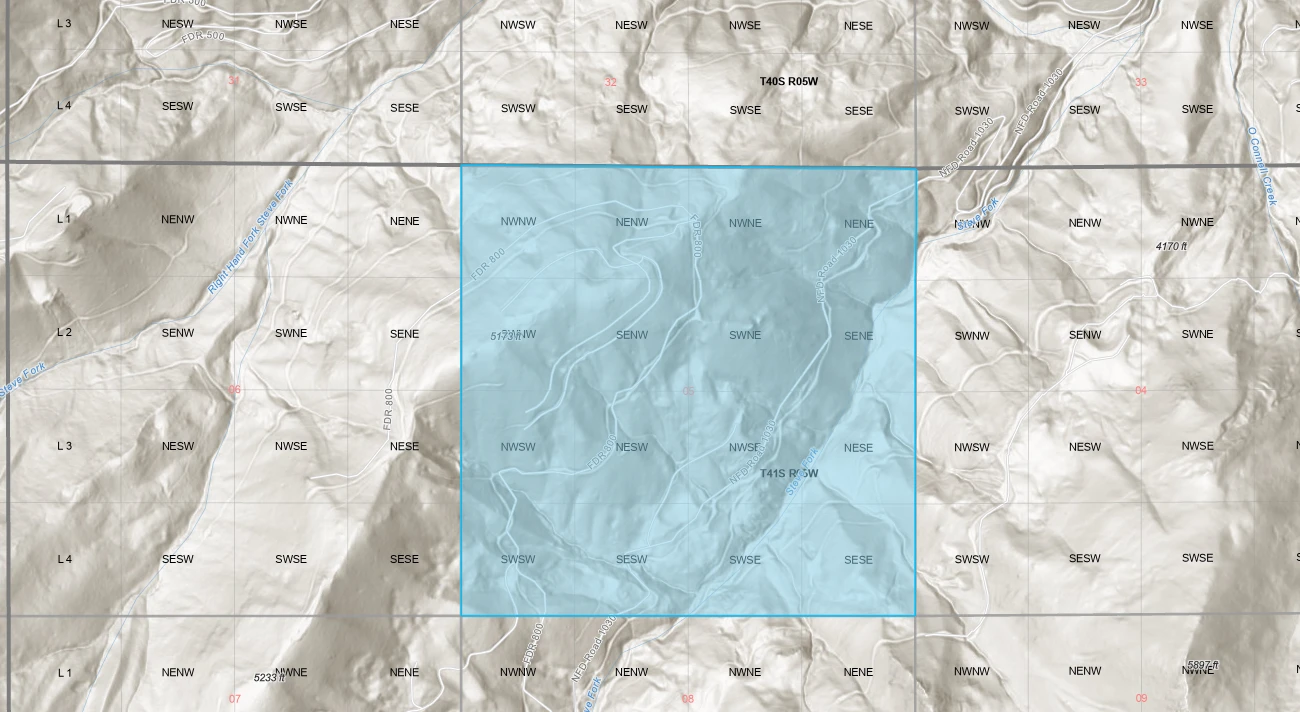
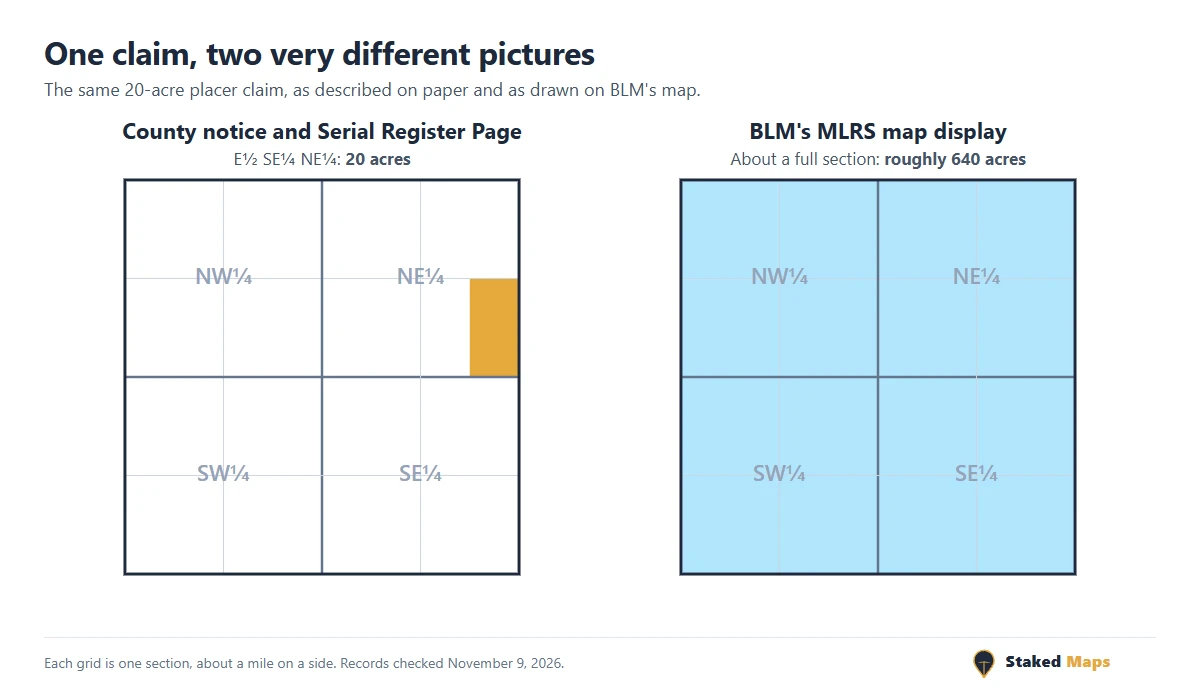
Step 4: what a buyer could get wrong. Someone relying only on the map could believe a small claim covered a whole section, including ground, roads and creeks that fall well outside its 20 acres. If a seller's ad leaned on that picture, the buyer would be paying for something the legal description doesn't support. The county notice and the register are what to compare, and BLM is the office to ask about any conflict.
Step 5: read the history as well as the status. The status is Active, and the case actions fill in the rest. They show accepted small miner waivers in recent years, which is exactly when a buyer should ask whether they would qualify too. They also show a February 2025 BLM decision citing missing proof of labor, followed in March 2025 by an entry vacating that decision and reinstating the claim. BLM's own remark says the payment had been in suspense because of an MLRS shutdown. A reader who saw only the word Active would miss that, and a reader who saw only the 2025 decision might wrongly assume the claimant had missed a filing.
Step 6: questions the records raise. Because the mapped claim area is incorrect, the surface management and withdrawal information must be checked against the 20-acre legal description, not the center of the oversized polygon. The BLM record also includes a "Subject to O&C" notation. Oregon's revested railroad grant lands have their own filing provisions and restrictions on timber use, so a prospective buyer should ask the appropriate BLM office to explain the notation and confirm which surface management and mineral estate restrictions apply to the actual claim location.
The lesson goes beyond one claim: even official systems can show conflicting or misleading information. Compare the county location notice, the MLRS Serial Register Page and the map, and don't let the map alone decide what you think you're buying.
What a map can show you, and what it can't
| Question | Map research | Documents | In the field |
|---|---|---|---|
| Is a claim recorded around here? | Yes, as a starting point | MLRS confirms | No |
| Exact boundaries | Approximate only | Location notice | Monuments, survey |
| Who holds it | No | MLRS and county deeds | No |
| Fees current | No | MLRS case actions | No |
| Surface manager | Yes | Agency confirms | No |
| Withdrawals | A strong lead | Withdrawal order, BLM office | No |
| Road or trail access | A lead | Easements, county records | Drive or walk it |
| Mineral value | Context only | Assays | Sampling |
| Hazards | Rarely | Agency files | Site visit, with care |
How Staked Maps fits into this research
Staked Maps puts recorded BLM claims, surface management and other public land layers on one map, so you can see a claim in context before spending money on a trip or a title search. It's a research tool. BLM's records and county filings remain the authority, and Staked Maps can't certify ownership, legal validity or mineral value.
| In Staked Maps | Free account | Single State, Tri-State or All-West |
|---|---|---|
| Current claims on the map, with name, type, status and size | One state you choose | Your plan's states |
| Surface Management layer | Yes | Yes |
| Serial number, legal location, link to BLM's record | Locked | Yes |
| PLSS grid and BLM Mineral Withdrawals | Locked | Yes |
| Expired and historical claims | Locked | Yes |
| My Research: saved claims, notes and projects | Locked | Yes |
| Claim Sluice: alerts on status changes and closures for watched claims, and new claims in watched areas | Locked | Yes |
Claim records in Staked Maps don't show claimant names, so check ownership in MLRS. BLM's reports are free for anyone with a serial number, which means a free account plus MLRS still lets you do useful early research. A paid plan shortens the trip between the map and the record, keeps your notes on each candidate claim together, and can alert you if a watched claim's status changes or it closes while you negotiate. Claim Sluice doesn't track ownership transfers or individual filings, so keep checking MLRS for those. Eligible free accounts that have never subscribed may be offered a one-time 24-hour Premium Preview of the viewing features in their chosen state.
Research a Mining Claim Before You Buy. Find the claim on the map, see the land around it, then take the serial number to BLM's records.
Open the MapDocuments to request before you make an offer
Ask for copies of all of these. A seller with a sound claim should have most of them ready.
- BLM serial number for every claim in the sale
- County-recorded location notice and map, plus any amendments
- Every deed in the chain from the original locator to the seller
- Maintenance fee receipts or accepted waivers for recent years
- Affidavits of assessment work, if waivers were used
- Any notice, plan of operations, bond or agency correspondence
- Assay certificates, sample locations and lab names
- Bill of sale listing equipment, with proof the seller owns it
- Water right documentation, if one is claimed
- Road or easement documents for any access across private land
- Authority to sign, if the seller is a company, estate or agent
- Draft deed and purchase agreement
When to walk away or bring in help
Walk away if the seller:
- Won't provide a serial number or copies of recorded documents
- Isn't the claimant of record and can't document how they got the interest
- Demands payment before you can verify anything, or only accepts hard-to-reverse payment
- Describes the claim as land you'll own, a homesite or a guaranteed gold producer
- Won't allow a site visit or independent sampling
- Can't explain a Closed or disputed status
Pay for help when a material amount of money is involved. A mining attorney can review title and draft the deed. A title or abstract professional can run the county chain. An independent geologist can design sampling. An environmental professional should look at any site with old workings, tailings or stored chemicals. The fee is small next to buying the wrong claim.
Other questions buyers ask
Is it legal to sell an unpatented mining claim?
Yes. An interest in a properly recorded claim can be conveyed in whole or in part, generally by quitclaim deed or another recordable document under state law. The sale moves the seller's interest, whatever that turns out to be.
Does a quitclaim deed guarantee anything?
Generally no. A quitclaim deed typically conveys only what the seller holds and offers no promise about title, which is why the checks above matter. Ask an attorney in your state about the exact effect.
Can I find a claim's owner from its name alone?
Sometimes. MLRS reports include a name index, but many claims share names, so confirm the serial number, county and legal description before relying on a match.
If a claim I want is Closed, can I just stake it?
Not safely. Closure doesn't mean the ground is open for location. It may be withdrawn, overlapped by another claim, or reinstated. Our guide to checking whether a claim exists covers that research.
Your pre-purchase checklist
Print this, or download the printable PDF.
Before you pay
- Sale terms state exactly what is being conveyed
- BLM serial number confirmed in MLRS by me
- Claim name, type, county and legal description all match
- Seller matches the claimant of record, and all co-claimants are signing
- Deed chain complete at the county recorder
- Status and case actions read and understood
- Fee or waiver confirmed for recent assessment years
- Waiver eligibility and the next September 1 payment settled
- County notice, Serial Register Page and map compared
- Monuments located on the ground
- Mineral evidence reviewed; independent sampling done if the price justifies it
- Surface manager contacted about access and allowed work
- Withdrawals and other restrictions checked
- Hazards, reclamation duties and bonds identified
- Equipment listed on a bill of sale
- Deed drafted to state requirements
After you pay
- Deed recorded with the county
- Transfer filed with the BLM State Office, with the fee
- MLRS rechecked to confirm your name appears
- Next maintenance fee or waiver on your calendar
Before any money changes hands
A seller's ad is an opening claim, and every part of it can be tested. Start with the free checks: get the serial number, read BLM's record, pull the county notice and compare the three. If the records hold together, spend money on a site visit, sampling and professional review. If they don't, you've saved the purchase price for the cost of an afternoon.
Start with the map. Look up the area and check the surface manager. Then verify everything in BLM's and the county's records.
Research a ClaimThis guide is general information and isn't legal advice. It was checked against current BLM guidance, the Code of Federal Regulations and Alaska DNR materials as of November 9, 2026. Fees and procedures can change, so confirm them with the BLM State Office before you act.
Sources
- 43 CFR 3833.1, 3833.32, 3833.33, 3833.92, 3830.91, 3809.116, 3821.2 and 3821.4 (Cornell Legal Information Institute)
- BLM, Mining Claim Fees: https://www.blm.gov/programs/energy-and-minerals/mining-and-minerals/locatable-minerals/mining-claims/fees
- BLM, Recording a Mining Claim or Site: https://www.blm.gov/programs/energy-and-minerals/mining-and-minerals/locatable-minerals/mining-claims/recording
- BLM Eastern States, Investigate Before Buying a Mining Claim: https://www.blm.gov/sites/default/files/docs/2021-10/Eastern%20States%20Mining%20Claim%20Brochure.pdf
- BLM, Mining Claims and Sites on Federal Lands: https://www.blm.gov/sites/default/files/PublicRoom_Mining_Claims_Brochure-2019.pdf
- BLM, Mining Claim Filing and Fee Requirements (updated February 9, 2026): https://www.blm.gov/sites/default/files/docs/2026-02/20260209_Encl1_MiningClaimFilingRequirements.pdf
- BLM Oregon/Washington Mining Claim Packet: https://www.blm.gov/sites/default/files/docs/2022-08/orwa-mining-claim-packet.pdf
- BLM Mineral & Land Records System reports: https://reports.blm.gov/reports/MLRS
- BLM Mining Claims map service, queried November 9, 2026
- County recorded location notice and BLM Serial Register Page for the worked example (identifying details withheld)
- Alaska Department of Natural Resources, Buyer Beware (2024): https://dnr.alaska.gov/mlw/mining/pdf/Buyer-Beware-2024.pdf
- U.S. Geological Survey, Mineral Resources Data System: https://mrdata.usgs.gov/mrds/