
The Short Answer
Generally, no, not as a home or a getaway cabin. This article covers unpatented mining claims on BLM-administered public lands, where 43 CFR Subpart 3715 sets the occupancy rules discussed below. Claims can also exist on National Forest System land, where the Forest Service administers the surface under a related but separate framework. A mining claim grants the right to develop and extract minerals, plus reasonable use of the surface for activities directly tied to that work. Building a residential structure doesn't qualify on its own. BLM applies a specific, narrow test for when any occupancy, including a structure that could function as shelter, is actually allowed, and simply holding a valid claim doesn't automatically satisfy it.
This Only Applies to Unpatented Claims
Almost every claim staked today, and almost every claim you'll find on a current map, is unpatented: a possessory right to the minerals, not ownership of the land itself, which is exactly why the occupancy rules below exist at all. Patented claims are a different, much rarer thing. Congress has prevented BLM from accepting new mineral patent applications since October 1, 1994, a moratorium renewed annually through appropriations ever since. Some applications already far enough through the patent process at that point were grandfathered and could continue, but a claimant today cannot file a new application to patent an unpatented mining claim while the moratorium remains in effect. The small number of patented claims that exist convey full title to the land, and in most cases the minerals and surface both, the same as any other deeded private property, so an owner can typically build a house on one without running into any of the rules that follow. If you're not sure which kind of claim you're dealing with, assume unpatented, since that's what virtually all current claim records reflect.
The Real Test: "Reasonably Incident"
Under BLM's surface management regulations (43 CFR Subpart 3715), any use or occupancy has to be "reasonably incident" to actual mining operations. In practice that means the activity must constitute substantially regular work on the claim, be reasonably calculated to lead toward extracting and processing minerals, involve observable on-the-ground activity BLM can actually verify, and use appropriate equipment that's presently operable, not stored, not decorative, not waiting for someday. For occupancy that goes beyond that baseline, actually staying on the claim rather than just working it, the claimant must also satisfy at least one additional requirement under 43 CFR §3715.2-1: a genuine need to protect valuable minerals or nonportable mining equipment, protect the public from safety hazards, protect the workings themselves, or isolation severe enough that workers couldn't otherwise get to and from a normal shift. Actively mining a claim, by itself, doesn't automatically justify living there. A structure is only justifiable to the extent it genuinely supports that kind of real, ongoing work. Wanting a cabin because the location is beautiful, or because you visit a few times a year, doesn't meet the test. The test is about mining activity, not lifestyle.
The 14-Day Rule
Even short-term camping tied to legitimate work has a ceiling. Once occupancy exceeds 14 calendar days in any 90-day period within a 25-mile radius, BLM's occupancy rules for mining claims come into play: you must consult with BLM and obtain concurrence for the proposed occupancy. Depending on the mining activity and the level of surface disturbance, your operation may also require a Notice of Intent or an approved Plan of Operations, though the 14-day threshold on its own doesn't automatically trigger that requirement. This is one of the most common ways people run into trouble without meaning to. Nothing about spending a long stretch of time on a claim is automatically fine just because it's your claim.
What You Actually Need Before Building Anything
Structures tied to occupancy on a claim fall under BLM's Subpart 3715 rules, and BLM concurrence is required before you occupy a claim in a way that involves them. Mining roads, support facilities, and other surface disturbance are separately governed by 43 CFR Part 3809, where a Notice of Intent or Plan of Operations may apply depending on the operation, and fences, gates, or signs meant to exclude the public specifically require BLM concurrence. For the cabin question, the point that matters is simpler: you cannot construct or maintain a cabin, or any other structure meant for occupancy, and simply assume that holding a mining claim authorizes it. "Tool shed" and "cabin" aren't meaningfully different to BLM if the structure could function as a place to sleep. This isn't a formality to skip; it's the actual mechanism that determines whether a structure is legal to have there at all.
What Usually Passes vs. What Usually Doesn't
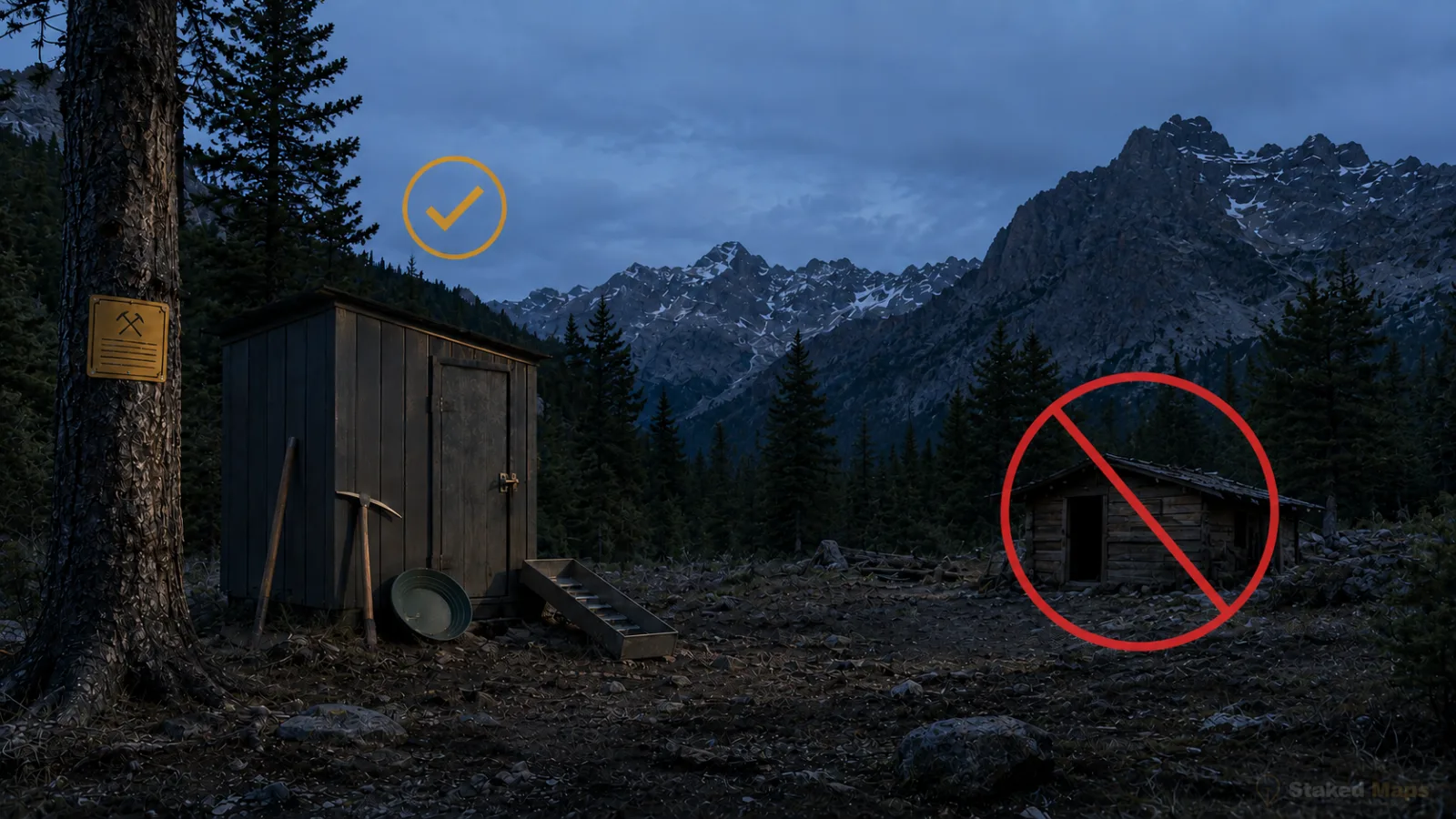
In practice, the line tends to fall in predictable places. A small, temporary tool shed or tent setup tied to genuine, ongoing surface work has a real shot at qualifying for the duration of that work, since the activity behind it is verifiable. Permanent structures are a separate question: BLM's rules generally prohibit them where the underlying work is surface-only prospecting or exploration, while a permanent structure tied to real subsurface mining activity may be allowed with BLM concurrence. A finished cabin with plumbing, a permanent foundation, or anything clearly built for comfortable year-round living almost never qualifies where the actual work behind it doesn't rise to that level. The relevant contrast isn't seasonal versus year-round mining; genuinely recurring seasonal work can still count as substantially regular work under the rule. It's genuine, recurring mining activity versus occasional recreational visits or token activity meant to justify having a residence there. BLM isn't evaluating how nice the structure is; it's comparing the structure to the work, and a mismatch between the two is exactly what draws scrutiny.
Why the Line Is Drawn Here
An unpatented mining claim gives you a possessory interest for mining purposes. It does not give you fee-simple ownership of the federal land, or a general right to use the claim as residential property. If occupancy weren't restricted this way, claims could become a backdoor for building vacation homes or residences on public land without any real mining ever happening, which is exactly the loophole the reasonably-incident standard exists to close. The rule isn't arbitrary red tape; it's the difference between a mining claim and a homestead, which are deliberately two different legal things, and it's part of why the 1994 patenting moratorium above matters so directly: without new patents converting claims into private land, the occupancy standard is the only thing keeping that line intact.
What Happens If You Build Without Approval
A structure or occupancy that doesn't meet the reasonably-incident test, approved or not, is treated as unauthorized use of public land, which is trespass. BLM can require removal of the structure, and the cost and hassle of that, demolition, hauling materials out, restoring the site, falls entirely on the claim holder, not BLM. There's no grandfathering in for a structure that's been standing for years unnoticed; a claim being decades old doesn't make an unauthorized cabin on it any more legal than one built last month. This is a genuinely common and expensive mistake, usually made by someone who assumed "I have a valid claim" was the same thing as "I can put a structure here," which it isn't.
The Bottom Line
A legitimate work-support structure, an equipment shed, a small structure tied to real, regular, verifiable mining activity, approved through the right process, is a completely different thing from "I own a claim so I can put a cabin here." One is a narrow, documented exception; the other is one of the most persistent misunderstandings in mining law, and it's worth getting right before you build anything at all.