
A mining claim's status in BLM's records tells you where that claim sits in BLM's paperwork. It does not tell you, by itself, whether the ground is open to prospect or stake.
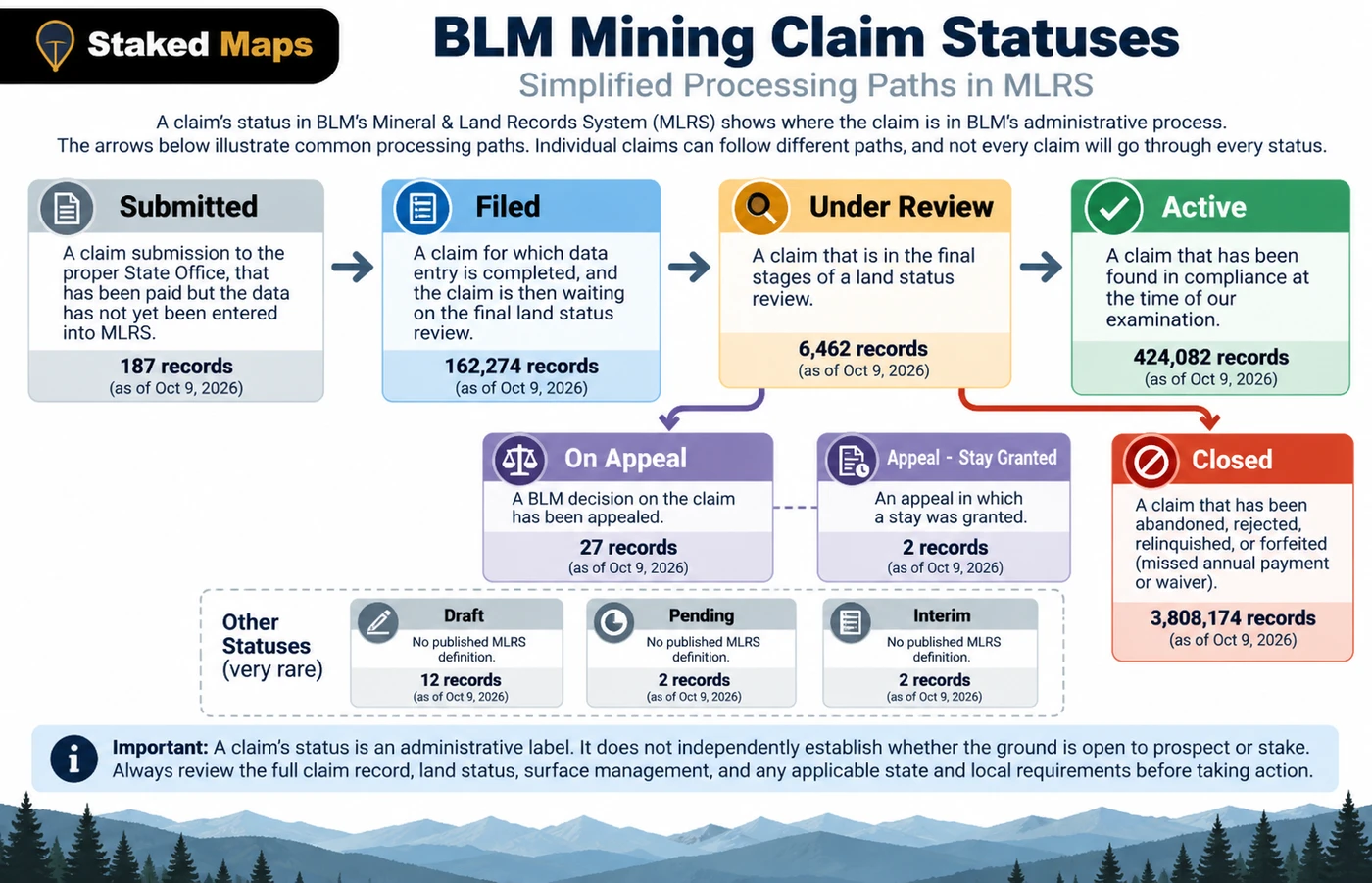
BLM's Mineral & Land Records System (MLRS) gives every federal mining claim a case disposition, the field most maps label "Status." Only one value, Closed, means the claim is no longer in force in BLM's records. Every other value, including Filed, Submitted, Under Review and On Appeal, belongs to a claim that is still on the books. As of October 9, 2026, nearly 169,000 current federal claim and site records carried a status other than Active.
A status is BLM's administrative record, not a ruling on whether a claim is legally valid. Still, the prudent approach is to treat a claim marked Filed or Under Review as a claim that may hold the ground and verify it before you prospect or stake there. A claim marked Closed is a lead worth checking, not a green light. The sections below give BLM's own definition of each status, show how common each one is, and walk through how to check a claim that isn't marked Active.
A note on dates: this guide was published October 14, 2026, but its numbers were gathered earlier and were not refreshed on publication day. National counts come from BLM's MLRS map service as queried October 9, 2026, five days before publication. State figures come from Staked Maps' October 5, 2026 sync. Statuses keep changing as BLM processes filings, so check a specific claim's current record before relying on it.
What the Status Field Is Actually Measuring
A claim's status is an administrative label. It records how far BLM has gotten in processing the claim's paperwork and checking its land status. It is not a court ruling on whether the claim is valid, and it says nothing about who manages the surface, whether the area is withdrawn or whether you can legally reach it.
The label set is also fairly new. When BLM replaced its old LR2000 system with MLRS on January 25, 2021, it expanded the dispositions. A 2024 BLM Nevada State Office presentation puts it plainly: "In LR2000, there were only two different dispositions. Claims were either Active or Closed. In MLRS we now have additional dispositions, to better keep the public informed."
That history explains a lot of the confusion. Older guides, forum posts and some mapping tools still treat claims as either active or closed. In MLRS, the in-between statuses cover a large share of current claims.
Even BLM's own map service adds to it. The layer BLM publishes for current claims is named "Active Mining Claims," yet it holds every claim that isn't Closed: Active, Filed, Under Review, Submitted and the rest. BLM's public data catalog calls the same dataset "Mining Claims Not Closed." A map that says it shows "active claims" may be showing all of those statuses, or only the ones labeled Active. You have to check which.
BLM's Definitions of Each Mining Claim Status
BLM's Nevada State Office published official definitions for the five main statuses in its 2024 MLRS training material. The middle columns below quote BLM directly. The last two columns are Staked Maps' guidance for prospectors, not BLM's wording.
| Status | BLM's definition | Current records (Oct 9, 2026) | What you can reasonably conclude | What it does not tell you |
|---|---|---|---|---|
| Submitted | "A claim submission to the proper State Office, that has been paid but the data has not yet been entered into MLRS." | 187 | A claim submission has been paid for and received by a BLM state office. Verify before prospecting or staking. | Whether the claim meets every recording requirement, or exactly where it is. Almost none of these records have a mapped shape yet. |
| Filed | "A claim for which data entry is completed, and the claim is then waiting on the final land status review." | 162,274 | BLM has finished data entry for the claim, and it is waiting on land status review. Verify before prospecting or staking. | Whether BLM has confirmed the land was open when the claim was located, or whether the claim is legally valid. |
| Under Review | "A claim that is in the final stages of a land status review." | 6,462 | The claim is in the final stages of land status review. Verify before prospecting or staking. | How the review will end. It can end Active or Closed. |
| Active | "A claim that has been found in compliance at the time of our examination." | 424,082 | BLM has completed its land status check and found the claim in compliance. | That the claim is valid under the mining law, or that this year's fee has been paid since BLM last looked. |
| Closed | "A claim that has been abandoned, rejected, relinquished, or forfeited (missed annual payment or waiver)." | 3,808,174 | That claim no longer holds the ground in BLM's records. | Whether the ground is open. A newer claim, a withdrawal or private land can still cover it. |
Current record counts are from BLM's national MLRS mining claims map service, queried October 9, 2026. They include mining claims and mill and tunnel sites in every state BLM administers. The Closed count covers every closed record in the service, going back decades.
BLM explains what the land status check confirms in an MLRS help article: a "land status checked" entry "indicates that an adjudicator has verified that the land where the claim or site is located was open to mineral location and entry at the time of location."
That is a narrower question than many people assume. The check confirms the land was open to mining claims when the claim was staked. It is not a mineral examination of whether the claim holds a valuable mineral deposit, and it does not settle disputes between claimants.
The Rare Statuses: On Appeal, Pending, Interim, Draft
A few other values show up in BLM's data in very small numbers, 232 records in all as of October 9, 2026. Together with the Filed and Under Review claims, that makes 168,968 current records with a status other than Active. BLM's published definitions don't cover most of these rare values, so here is what can be said about each without guessing.
| Status | Current records (Oct 9, 2026) | What is documented |
|---|---|---|
| On Appeal | 27 | A BLM decision on the claim has been appealed. The appeals rules are covered below. |
| Appeal - Stay Granted | 2 | The label indicates an appeal in which a stay was granted. The stay order itself controls what it suspends. |
| Draft | 12 | BLM defines "Draft" for case actions (filings within a case) as "not completed and not paid (claimants filing online)." It does not publish a separate definition for Draft as a claim status. |
| Pending | 2 | No published MLRS definition for mining claims. BLM also uses "Pending" in other programs, such as mineral withdrawals and mineral materials, which are different kinds of cases. |
| Interim | 2 | No published MLRS definition for mining claims. Like Pending, it is used in other BLM programs. |
For any of these five, the only reliable move is to look up that specific claim's record or call the BLM state office that administers it. With two or three records nationwide, a general rule would just be a guess.
Does "Filed" Mean the Land Is Already Claimed?
Treat it as claimed until you've checked the record. BLM defines Filed as a claim whose data entry is complete and which is waiting on the final land status review. Nothing in that definition suggests a Filed claim is a mere application that others can ignore. The status alone doesn't establish that the claim is legally valid or that every recording requirement has been met. Those answers are in the claim's record, not its status label.
Filed claims are also not new by definition. BLM's MLRS help article says that when claims moved over from LR2000, "any active claims not yet showing that the land status had been checked were set to a 'Filed' status in MLRS." Some of those have never moved on. As of October 9, 2026, 12,213 claims marked Filed carried a legacy LR2000 serial number, which means they were in BLM's records before MLRS launched in January 2021 and were still marked Filed more than five years later.
How much of a state's claim record is Filed varies widely. That makes a map's definition of "active" matter more in some states than others.
| State | Current federal records | Active | Filed | Under Review | Other statuses |
|---|---|---|---|---|---|
| Utah | 43,756 | 41.5% | 58.1% | 149 | 23 |
| California | 28,875 | 49.8% | 49.6% | 159 | 10 |
| Idaho | 41,556 | 52.2% | 47.3% | 222 | 3 |
| Wyoming | 49,395 | 57.1% | 41.5% | 704 | 20 |
| Oregon | 11,404 | 76.4% | 23.3% | 30 | 7 |
| Nevada | 279,382 | 76.1% | 22.7% | 3,368 | 151 |
| Washington | 2,634 | 79.4% | 20.3% | 9 | 0 |
| Arizona | 65,749 | 83.1% | 15.4% | 969 | 2 |
| New Mexico | 14,502 | 83.2% | 12.6% | 614 | 0 |
| Colorado | 15,086 | 87.3% | 12.1% | 66 | 12 |
| Alaska (BLM federal only) | 9,975 | 89.2% | 9.6% | 119 | 0 |
| Montana | 20,654 | 97.4% | 2.5% | 32 | 2 |
| South Dakota | 9,156 | 99.9% | 0.1% | 2 | 1 |
Source: Staked Maps database, BLM statuses as of the October 5, 2026 sync. "Other statuses" counts Submitted, On Appeal, Appeal - Stay Granted, Draft, Pending and Interim records. Alaska figures exclude the roughly 40,000 state mining claims recorded separately with the Alaska Department of Natural Resources.
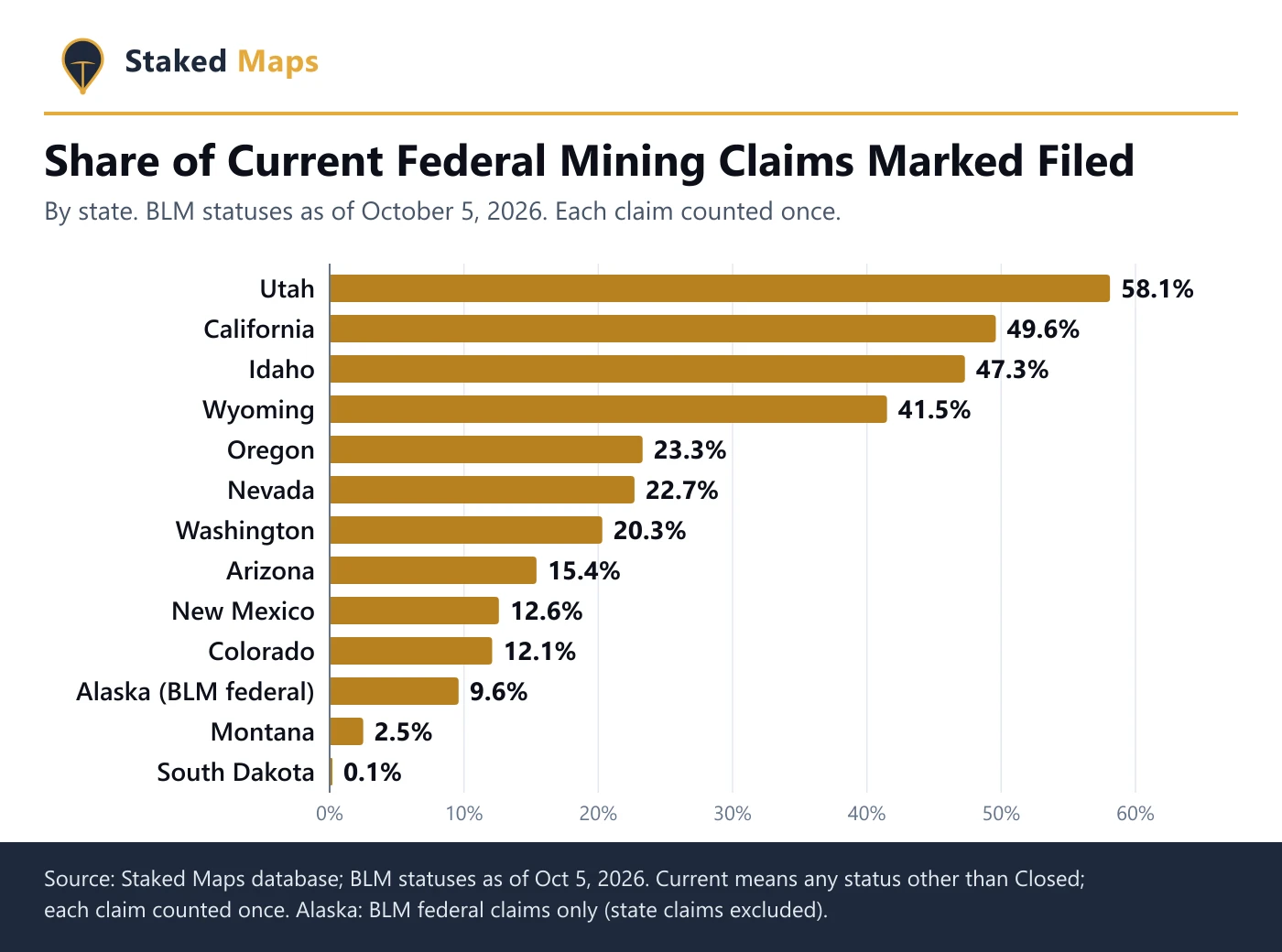
In Utah, more current claims are Filed than Active. A map that shows only claims labeled Active would leave out more than half of Utah's current claims, and about half in California and Idaho. Each state's page, such as our Utah, California and Idaho mining claim maps, breaks its current claims down by BLM status. Someone using an Active-only map could look at a blank spot and think it was unclaimed when it is covered by a claim BLM simply hasn't finished reviewing.
Oregon is a useful example of how mixed the picture can be. Its 11,404 current records include three of the rare statuses above: five On Appeal, one Pending and one Interim, alongside 8,708 Active and 2,659 Filed claims. The Oregon mining claims map shows them by county.
These percentages describe BLM's record status, not mining activity. BLM hasn't published an explanation for why the Filed share differs so much between states, so the table shouldn't be read as a measure of any state office's workload.
Can You Prospect on a Claim That's Pending or Under Review?
As a precaution, not without checking the record and, where the claim holds up, getting the claimant's permission. Under Review means the claim is in the final stages of BLM's land status review. Until that review ends, the claim stays on BLM's books. Whether an activity needs permission also depends on what you plan to do: removing minerals from a valid claim is a different question from walking across the surface.
BLM's help article describes the two ways a review can end. The claim "may be set to 'Active', OR it may be set to 'Closed' if your claim/site is on lands not open to mineral location." If the review closes a claim, BLM notifies the claimant. A status of Under Review tells you the outcome is undecided. It doesn't tell you the outcome is likely to go either way.
Pending is too rare on mining claims (two records nationwide as of October 9, 2026) to support a general rule. As a working rule, treat any status other than Closed as a claim to verify before you prospect or stake.
What "On Appeal" Means for a Mining Claim
On Appeal means a BLM decision about the claim, such as a decision declaring it forfeited, has been appealed to the Interior Board of Land Appeals (IBLA). The appeal itself doesn't necessarily put that decision on hold.
Under the current 43 CFR 4.405, revised effective May 21, 2026, a BLM decision generally isn't effective during the time allowed to file an appeal. After that window, it takes effect unless the appellant filed a petition for a stay along with the appeal. If the Board denies the stay, or doesn't rule on it within 45 days after the appeal window closes, the decision takes effect while the appeal continues. Only a granted stay keeps the decision from taking effect while the appeal is pending, which is why "Appeal - Stay Granted" and "On Appeal" are worth telling apart. Separately, under 43 CFR 4.404, once an appeal is filed, BLM can't change the decision on its own without first asking the Board for a remand.
For a prospector, the practical answer is simple. A claim on appeal is in dispute, and the status label alone won't tell you whether BLM's decision is currently in effect. The cautious approach is to stay off it and not stake over it until the appeal is resolved, and to follow the case in MLRS if the ground matters to you.
Does "Closed" Mean the Ground Is Open for Staking?
No. A Closed status means that particular claim no longer holds the ground in BLM's records. It says nothing about what else might cover the same land.
When you find a Closed claim, check for these:
- A newer claim. A closed claim and a current claim can cover the same ground. Closing one claim doesn't clear the others.
- A mineral withdrawal. Land can be withdrawn from mineral entry after an old claim was located.
- Private or patented land. A claim that went to patent became private property.
- Other land managers. National parks, some state lands and tribal lands follow different rules entirely.
There is one detail most guides miss. Under 43 CFR 3830.91(b), a claim is forfeited if it was located "on lands closed to mineral entry at the time you locate it." BLM's land status review is how those claims get caught. So when a claim was closed after a land status review, that closure can be a sign the ground was not open to claims. The record's case history is where you find out why the claim closed.
Our guide to abandoned mines and historical mining claims covers what old claim records can and can't tell you about a piece of ground.
Can a Closed Mining Claim Be Reinstated?
It depends on why the claim closed. Four different situations tend to get lumped together:
- Statutory forfeiture. Failure to pay the annual maintenance fee is a forfeiture the law makes automatic. Under 30 U.S.C. § 28i, failure to pay "shall conclusively constitute a forfeiture," and the claim "shall be deemed null and void by operation of law." BLM's regulations at 43 CFR 3830.93 call defects in statutory requirements "incurable." A claim forfeited this way doesn't come back.
- Curable regulatory defects. When a filing has a defect in a regulatory (not statutory) requirement, BLM notifies the claimant, who generally has 30 days to fix it, or 60 days for a defective small miner waiver request, under 43 CFR 3830.94. The claim is forfeited only if the claimant misses that deadline, after which BLM issues a final decision.
- Appeals. A BLM decision closing a claim can be appealed to IBLA. If the Board reverses the decision, the claim's record can change again. Whether the decision was in effect during the appeal depends on the stay rules above.
- A new location. A former claimant whose claim went void can't revive the old claim. If the ground is open, they can stake and record a new claim, the same as anyone else. That claim gets its own serial number and location date, so it is a new claim, not a reinstated one. Our guide on how long a mining claim lasts explains how claims go void and what restaking involves.
A Closed record from years ago is unlikely to come back. A recently closed claim is different, because an appeal window or cure period may still be running. That is one more reason to read the record's case history instead of stopping at the status label.
Why a Claim Shows Up on One Map but Not Another
Two mining claim maps can disagree about the same piece of ground for several ordinary reasons. None of them requires an error on anyone's part.
1. One map shows only "Active." As the state table above shows, a map filtered to the Active status can leave out anywhere from well under 1% to about 58% of a state's current claims.
2. Some claims have no mapped shape. As of October 9, 2026, more than 12,000 current records in BLM's national map service had no geometry at all, including 184 of the 187 Submitted claims. A map built only from BLM's shapes can't draw them. BLM's own metadata notes that "geospatial representations might be missing for some cases that can not be geocoded." When BLM has recorded a legal description but no shape, Staked Maps approximates the claim's location from that description where it can. When BLM's record contains no location at all, no map built on BLM data, BLM's own included, can place it. For those claims, the Serial Register Page or the BLM state office is the place to check.
3. Maps update on different schedules. BLM updates MLRS as it processes filings. Mapping tools copy that data on their own schedules, so a claim closed or added this week may not appear on a map yet.
4. New claims have a 90-day recording window. Under 43 CFR 3830.91(a)(1), a claim must be recorded with BLM within 90 days after it is located. A claim staked on the ground last month may not be in any federal database yet. The county recorder is also part of the picture, as our guide on how to find out if a mining claim exists explains.
5. Claims can be filed under another state's serial number. BLM's Oregon/Washington State Office administers Washington claims, and its Montana/Dakotas State Office administers South Dakota claims. A Washington claim can carry an "OR" serial number and a South Dakota claim an "MT" number. A tool that assigns claims to states by serial prefix alone can miss them.
6. Alaska has two claim systems. Federal claims in Alaska are recorded with BLM. State mining claims on Alaska state land are recorded with the Alaska Department of Natural Resources, a completely separate system. A map that shows only one of them shows only part of Alaska.
Active vs. Current: Two Different Counts
"Active" is a BLM status value. "Current" or "not closed" is a grouping: every claim whose status is anything other than Closed. The two numbers differ, sometimes by a lot.
Staked Maps uses both terms on purpose. Its claims layer includes current federal claims of every status, not just Active ones, because a Filed claim is still a claim on BLM's books. (The exception is the small share of records with no mappable location, described above.) The claim's exact BLM status appears in its popup, so you can tell an Active claim from a Filed one at a glance. When our state pages give a count of "current" claims, that count includes every non-Closed status. When they say "Active," they mean the BLM status.
The "current" label is Staked Maps' own grouping and has no legal meaning. It just keeps a status label from hiding claimed ground.
How to Check a Claim That Isn't Marked Active
Here is a practical way to research a claim marked Filed, Under Review or anything else other than Active.
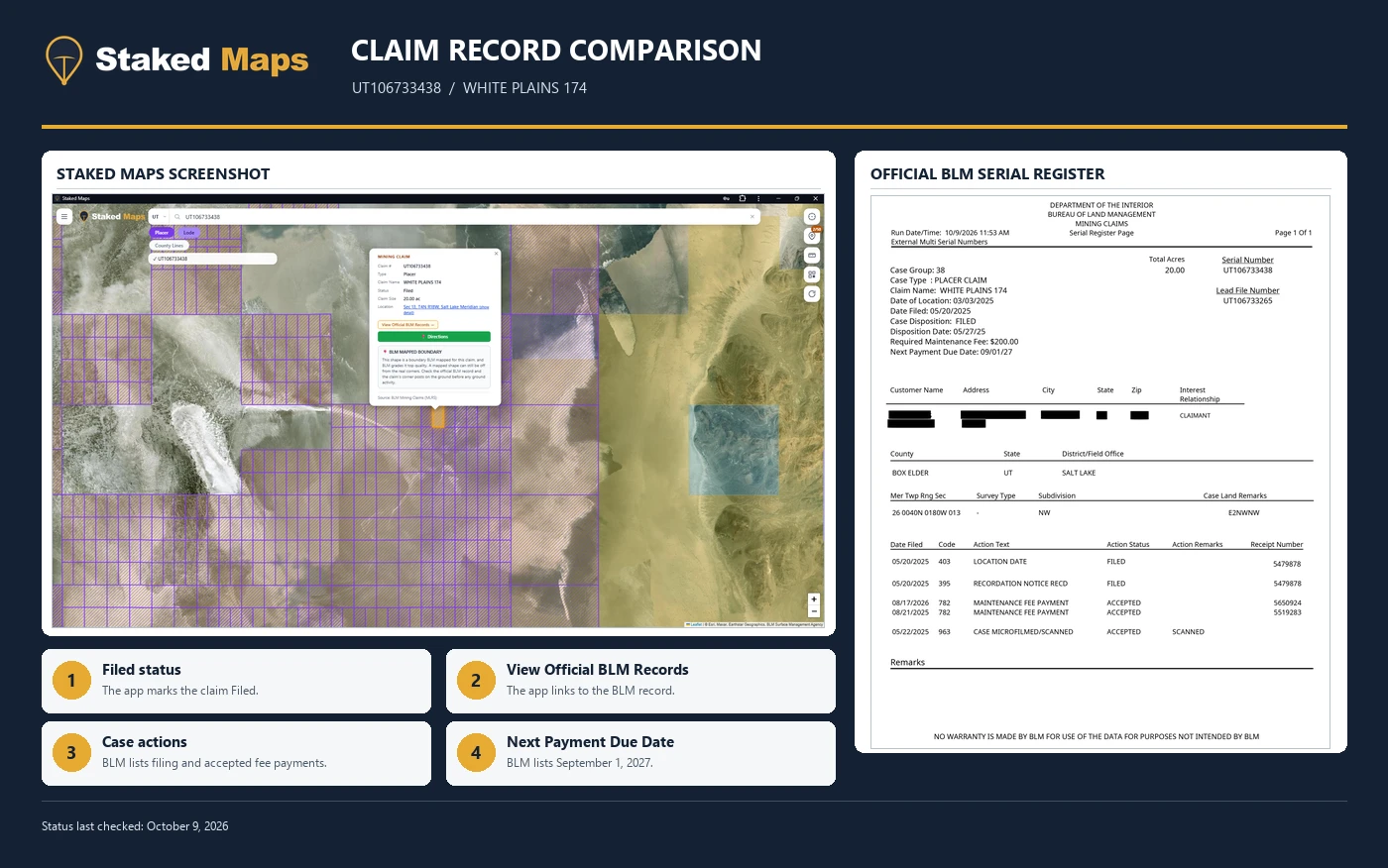
Step 1: Read the claim's popup. In Staked Maps, click the claim. The popup shows its BLM status, claim type, name and size, plus a "Status last checked" date telling you when Staked Maps last confirmed that status against BLM. On a paid plan it also shows the claim's serial number, its legal location and a View Official BLM Records button.
Step 2: Open the official record. The BLM record button takes you to the claim's Serial Register Page in BLM's public MLRS reports. You can also search BLM's reports site by serial number yourself. According to BLM's training material, the Serial Register Page lists the claim's case actions, such as maintenance fee payments, its claimant and location information, and a Next Payment Due Date.
Step 3: Check whether the claim is paid up. The status may lag reality. Annual maintenance fees are due by September 1. A claim that went unpaid becomes void by operation of law on its own, even if its status still reads Active or Filed until BLM processes it. Look at the case actions and next payment due date, not just the status.
Step 4: Search the area, not just the claim. If you don't have a serial number, BLM's MLRS Geographic Report lists every claim in a township, range and section. BLM's instructions use a fixed format: two digits for the meridian, then five characters each for township and range, then three digits for section (for example, Mount Diablo Meridian, T31N, R47E, Section 26 is entered as 21 0310N 0470E 026). On paid plans, Staked Maps' PLSS grid layer shows which township, range and section you are looking at, which saves a lot of guesswork.
Step 5: Check the land, not just the claims. A claim status says nothing about the land under it. Check surface management, mineral withdrawals and special designations for the same spot. Staked Maps shows surface management on every plan and a BLM Mineral Withdrawals layer on paid plans. Turning on Historical Claims (also on paid plans) shows closed claims in the area, which can point you to case histories worth reading.
Step 6: Ask the BLM state office when it's still unclear. Land status adjudication is done by the BLM state office that administers the claim. If the record leaves questions open, that office is the authority. A county recorder can tell you whether a newer location notice has been recorded locally.
Researching more than a single claim? Staked Maps puts current federal claims of every status and the land status layers around them on one map. Paid plans add a link from each claim to its official BLM record. Open the Staked Maps claim map
Staked Maps is a research tool. Its claim boundaries are interpreted from BLM's recorded legal descriptions, not surveyed lines. A status shown on the map is a copy of BLM's record as of the date in the popup. An empty area on the map does not mean the ground is open, because some recorded claims can't be mapped and new claims may not be recorded yet.
Other Questions About Claim Statuses
Is a Filed mining claim valid?
BLM's records don't answer that question for any status, Active included. A Filed claim is one whose data BLM has entered and whose land status review isn't finished. Validity under the mining law turns on things BLM's status field doesn't record, such as a valid discovery and proper location on the ground.
How long does a claim stay Filed or Under Review?
BLM doesn't publish a standard timeline. The status can last years: 12,213 claims that were in BLM's records before January 2021 were still marked Filed in October 2026. That doesn't mean every Filed claim waits that long.
Does an Active status mean this year's fee was paid?
Not necessarily. Active means BLM found the claim in compliance "at the time of our examination." If a fee deadline has passed since then, check the Serial Register Page for the latest case actions and the next payment due date.
Can I prospect on a Closed claim?
Only if the ground is otherwise open. Check for a newer claim covering the same ground, a withdrawal, private land and any local closure before you treat a Closed claim's ground as available.
Read the Status, Then Read the Record
A claim's status is the first thing to read, and it should never be the last. Treat every status except Closed as a claim to verify before you prospect or stake. Treat Closed as a reason to dig further, not as permission. Neither label, on its own, settles whether a claim is legally valid or whether the ground is open. When the status is unusual or a decision is recent, the claim's Serial Register Page and the BLM state office answer the questions a one-word label can't.
See Current Mining Claims and Their BLM Statuses
Explore current federal claim locations and their recorded statuses with Staked Maps. Start with the free map, then unlock additional claim details, official-record links, and research layers with a paid plan.
See Claims in My State FreeNo credit card required.
Staked Maps provides mapping and research information, not a legal determination that land is open to prospecting or claim location. Always verify current claim records, land status and applicable rules with the appropriate government agencies.
How These Numbers Were Counted
- National figures come from BLM's MLRS mining claims map service, queried October 9, 2026. The "Active Mining Claims" layer was counted by status: 424,082 Active, 162,274 Filed, 6,462 Under Review and 232 other, for 593,050 current records. The "Closed Mining Claims" layer gave the Closed count.
- State figures come from the Staked Maps database, with BLM statuses as of the October 5, 2026 sync. Each claim is counted once. BLM's Montana/Dakotas and Oregon/Washington state offices issue serial numbers that can belong to either state, so a claim is assigned to the state named in its legal description, or to its serial number's state when the record has no legal description.
- Record types: all counts include lode and placer claims plus mill sites and tunnel sites. Alaska state claims recorded with the Alaska Department of Natural Resources are excluded.
- "Current" means any BLM status other than Closed. It is Staked Maps' grouping, not a BLM status.
- Publication timing: this guide was published October 14, 2026. No figures were re-queried on that date, so each one carries the date it was actually pulled.
The two snapshots were taken on different dates and assign claims to states differently, so the state figures don't add up exactly to the national figures.
Sources
- BLM Nevada State Office: External MLRS Reports, case disposition definitions (2024 training presentation, hosted by the Nevada Division of Minerals)
- BLM Nevada State Office: MLRS Supporting Text (2024 training presentation, hosted by the Nevada Division of Minerals)
- BLM MLRS Help: Why did my case disposition change from Active to Filed?
- BLM: MLRS Mining Claims map service (Active and Closed layers)
- BLM: MLRS Mining Claims Not Closed dataset
- BLM Reports: MLRS public reports
- BLM: Mineral & Land Records System (MLRS)
- 30 U.S.C. § 28i: Failure to pay as forfeiture
- 43 CFR 3830.91: Failure to comply
- 43 CFR 3830.93: When defects are curable
- 43 CFR 3830.94: How to cure a defect
- 43 CFR 4.404: Effect of appeal
- 43 CFR 4.405: Effect of decision pending appeal; petitions for stay
Status definitions, counts and regulations checked October 9, 2026, and published October 14, 2026. BLM's records change as it processes filings. Confirm a specific claim's status in MLRS before acting on it.