

The Short Answer
A mining claim is a legal claim to the right to explore for and extract certain valuable minerals, gold, silver, and other "locatable" minerals, from a specific parcel of federal public land. It is not a claim to the land itself. The federal government still owns the ground; a claim simply gives the holder an exclusive right to work the minerals on that parcel, for as long as the claim stays in good standing.
That one distinction trips up more new prospectors than almost anything else in mining law, so it's worth sitting with before anything else.
You Get Mineral Rights, Not the Deed
Filing a claim doesn't put your name on a deed and it doesn't transfer title to the land. The Bureau of Land Management (BLM) still manages the surface, and in most cases the public can still walk, hike, camp, and even recreationally prospect on claimed ground, as long as they aren't interfering with the claim holder's actual mining operations. What a valid claim does give you is the exclusive right to develop and extract the minerals within its boundaries, and reasonable use of the surface for activities directly tied to that work: building an access road, setting up equipment, that kind of thing. It's a use right, not a property right in the way most people think of one.
There Are Actually Four Kinds of Claims, Not Two
Most explanations stop at lode and placer, since that covers what almost every recreational prospector deals with. But the General Mining Law of 1872 recognizes four distinct claim and site types, and the other two matter the moment you need ground to support a mining operation rather than ground that holds the mineral deposit itself.
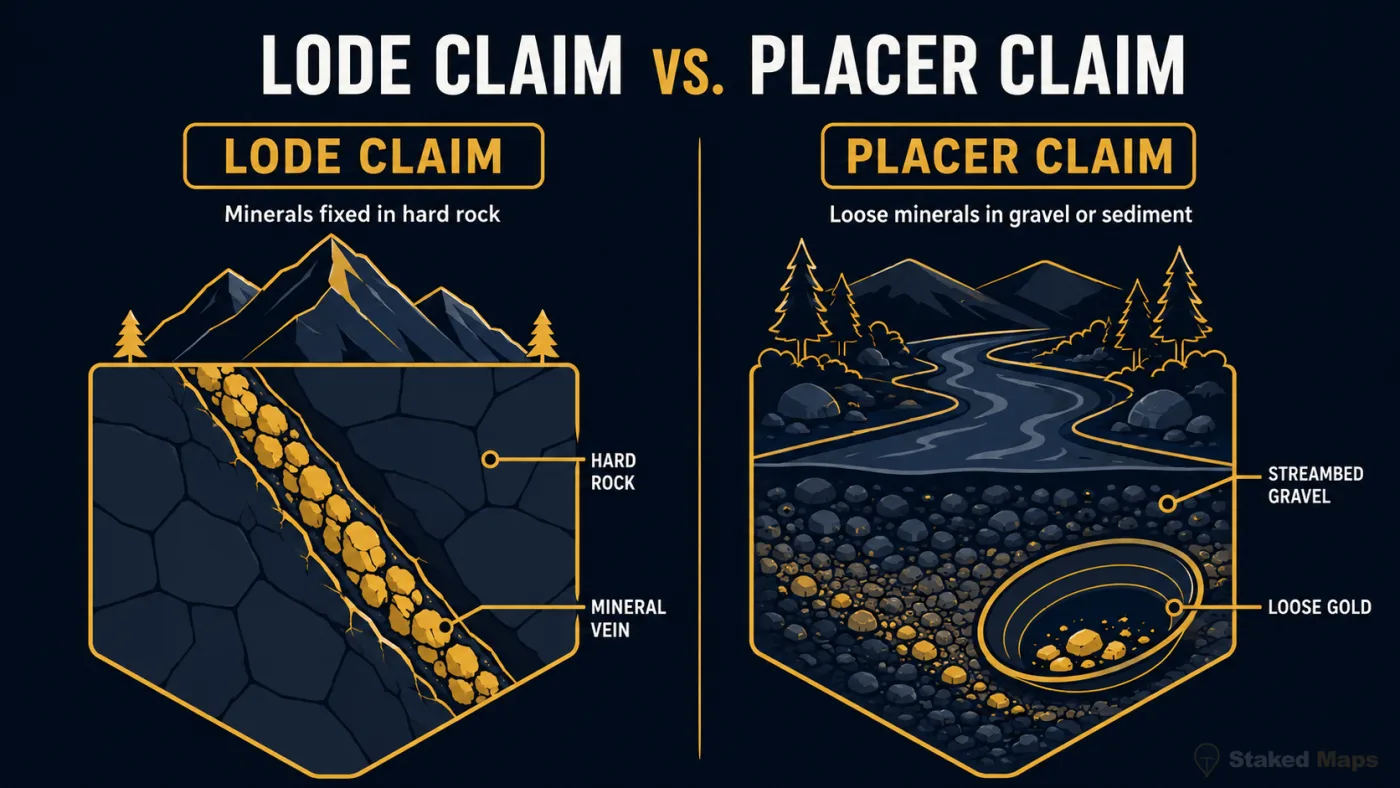
Lode Claims
A lode claim covers a mineral deposit still embedded in its original hard-rock formation, a vein or lode running through solid rock. These are the claims you'd associate with hard-rock mining: shafts, tunnels, and ore extracted directly from the rock it formed in. Federal statute caps a lode claim at 1,500 feet in length along the vein and 600 feet in width (300 feet on either side), which works out to a little under 20.7 acres, regardless of how many co-locators are on the filing.
Placer Claims
A placer claim covers minerals that have already broken loose from their source rock and been redeposited by water or erosion, think gold in a streambed, gravel bar, or old alluvial terrace. This is the category most recreational and small-scale prospectors deal with, since it covers the classic pan-and-sluice style of prospecting. A placer claim tops out at 20 acres for a single locator, or up to 160 acres for an association placer claim filed jointly by eight or more locators.
Mill Sites
A mill site isn't staked over a mineral deposit at all. It's up to 5 acres of non-mineral land set aside to support a nearby lode or placer operation: a place to put a mill, a tailings area, or equipment storage that doesn't need to sit directly on top of the ore. A mill site has to be noncontiguous from the claim it supports.
Tunnel Sites
A tunnel site is a subsurface right-of-way, up to 3,000 feet long with a 1,500-foot radius, driven to reach a blind vein that hasn't been discovered yet. It's the least common of the four by a wide margin and mostly shows up in established hard-rock districts with a long history of tunneling.
What It Actually Costs to Stake and Hold One
Filing a new claim carries three fees due at the same time: a $49 location fee, a $25 processing fee, and an initial $200 maintenance fee, per claim or site. After that first year, keeping a claim alive costs $200 annually for a lode claim, mill site, or tunnel site, and $200 for every 20 acres (or fraction of it) on a placer claim, due on or before September 1. Claimants holding 10 or fewer claims and sites nationwide can skip the annual fee entirely by instead performing at least $100 of labor or improvement work on each claim and filing proof of it with BLM by December 30, the small miner's waiver.
How a Claim Actually Gets Established
Staking a claim isn't just showing up with a metal detector. The process has real legal steps, and skipping one can make a claim invalid even if you did the physical work:
- Confirm the ground is open. Not all federal land is open to mineral entry: national parks, wilderness areas, wildlife refuges, and land already under a valid existing claim are off-limits. This step alone rules out a lot of ground people assume is fair game.
- Stake the physical boundaries. Claims are marked on the ground with corner posts or monuments, following the size and shape limits above for whichever claim type you're filing.
- File with the county. A Notice or Certificate of Location gets recorded with the county where the claim sits.
- File with the BLM. The same filing has to reach the BLM's LR2000/MLRS system within a statutory deadline, currently 90 days from the location date.
- Pay the fees. The location, processing, and initial maintenance fees above, then the annual maintenance fee (or the small-miner waiver) every year after.
Miss a filing deadline or let the annual fee lapse, and the claim can go from active to void, which is exactly why so much of the ground labeled "claimed" on paper is actually sitting open again.
For the BLM's own official walkthrough of this process, see their guide to staking a mining claim, and their current fee schedule for the exact numbers each year.
Active vs. Historical: Why the Label Matters
You'll see claims described as either active or historical, and the difference isn't cosmetic. Active claims have current, in-good-standing filings: someone is actively holding mineral rights to that ground right now. Historical claims are ones that expired, were abandoned, or closed out, whether because the fees lapsed, the deposit didn't pan out, or the claimant simply moved on. Historical claims are still genuinely useful: they're a record of where people found (or expected to find) something worth working, and they mark ground that may be open again today.
Myths That Get New Prospectors in Trouble
- "It's federal land, so I can dig anywhere." Only on ground that's actually open to mineral entry. Plenty of federal land, parks, monuments, wilderness, is withdrawn from mineral entry entirely, regardless of who owns the surface.
- "An active claim means the public is locked out." Not automatically. Recreational access, hiking, and even casual panning are often still allowed on claimed ground, as long as it doesn't interfere with the claim holder's operations, though local rules and specific claim conditions vary, so it's worth checking before you dig in.
- "If I found it, it's mine, no questions asked." Only if you were legally entitled to be prospecting that ground in the first place. Finding a nugget on someone else's valid active claim doesn't make it yours.
- "A claim is just a lode or placer claim." Not always. If you ever need ground for a mill, tailings storage, or a tunnel driven toward an undiscovered vein, that's a mill site or tunnel site claim, a separate filing with its own size rules.
Before You Stake, or Even Prospect, Check the Ground First
Claim status changes constantly: claims go void, new ones get staked, land status shifts. The single most avoidable mistake a new prospector makes is planning a trip, or worse, staking real time and money into a claim, based on outdated information. Before you commit to any ground, confirm its current status directly against the BLM's own records rather than word of mouth or an old map.