
The Short Answer
If you own land with mineral rights, hold a mining claim, or are researching ground you might want to prospect, these terms can sound interchangeable.
They aren't.
Mineral rights are an ownership interest in the minerals beneath a property. An unpatented federal mining claim is a possessory right to explore for and develop a discovered valuable deposit of locatable minerals on eligible federal land. The United States still retains title to the land and mineral estate.
That distinction affects everything from where you search for records to whether you can legally stake a claim. It also explains why a property deed, a mineral-rights map and a mining-claims map can show completely different information for the same piece of ground.
Important: Mining-claim records, surface-management maps and mineral-ownership records answer different questions. No single map by itself can establish mineral title, legal access or whether land is open to mineral entry.
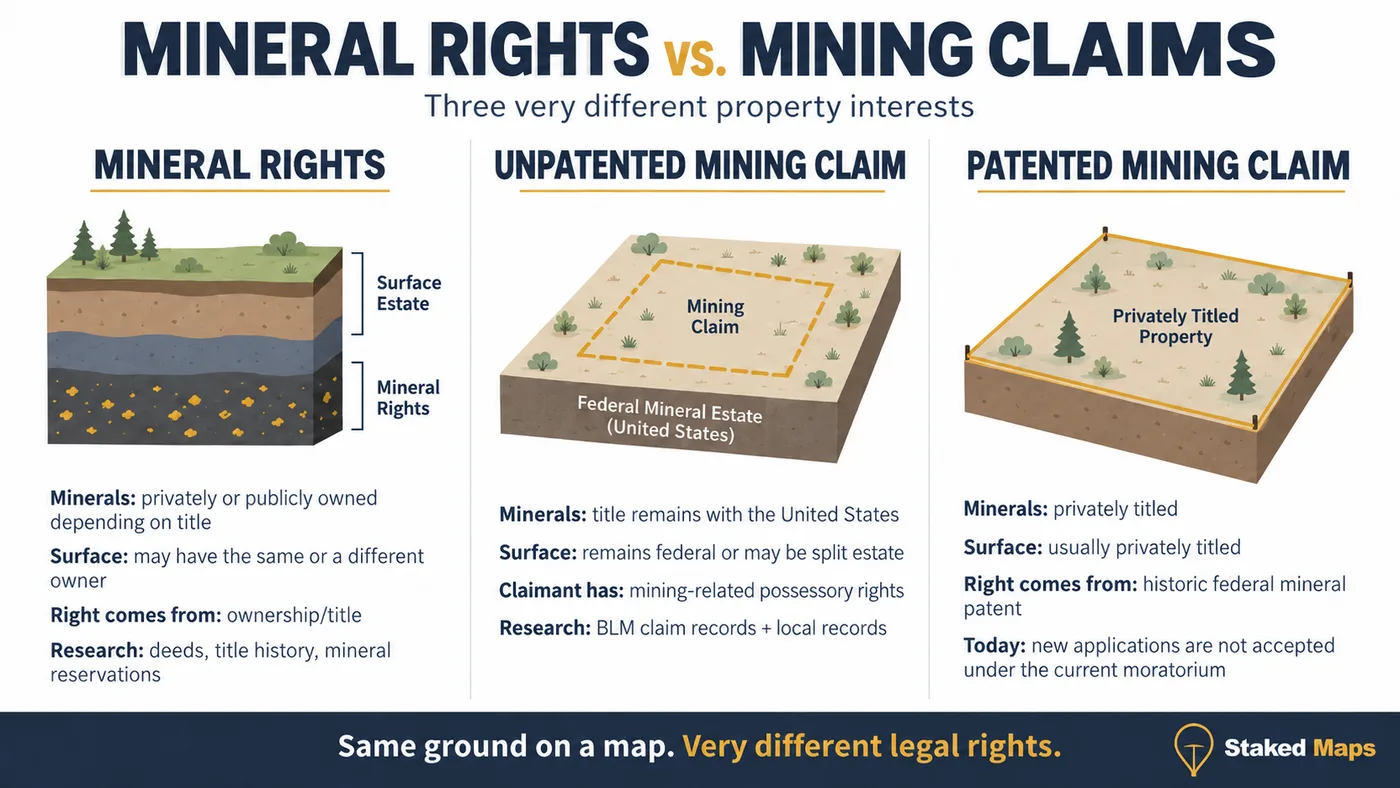
Mineral Rights vs. Mining Claims at a Glance
| Mineral rights | Unpatented federal mining claim | Patented mining claim | |
|---|---|---|---|
| What is it? | Ownership interest in a mineral estate or specified minerals | Possessory mining rights on qualifying federal mineral estate | Private title conveyed by the federal government through a mineral patent |
| Who retains title to the minerals? | The mineral owner | United States | Generally the private owner after patent |
| Does it automatically include the surface? | No | No | In most cases, a patent conveyed the surface as well |
| Can the interest be transferred? | Generally yes | Yes | Yes, as private real property |
| Can you simply stake it? | No | Only where federal land/minerals are open to mineral entry and mining-law requirements are met | No new patent applications are currently accepted under the longstanding congressional moratorium |
| Where do you research it? | Deeds, title records, mineral reservations and federal patent records | BLM mining-claim records, local recording records and field evidence | Property/title records and the historic patent |
| Does it prove the ground is open to prospecting? | No | No | No |
The important word in that table is unpatented. Most federal mining claims prospectors encounter today are unpatented claims, which are very different from privately owned patented mining properties.
Two Different Legal Systems
Mineral ownership largely comes from property law and the chain of title.
The mineral estate beneath a property can be owned together with the surface or severed from it. A previous owner might have sold the surface while reserving some or all mineral rights. A mineral interest can also be sold, inherited or leased separately from the surface estate.
That means the person standing on the land may not be the person who owns the minerals underneath it.
Federal mining claims operate differently.
Under the federal mining laws, a claimant can assert rights to qualifying locatable minerals on eligible federal mineral estate. BLM describes a mining claim as a parcel where the claimant has asserted a right of possession and the right to develop and extract a discovered valuable mineral deposit.
An unpatented mining claim does not give the claimant private title to the land and does not provide unrestricted ownership of the surface.
That is why asking "Who owns the mineral rights?" and asking "Is there a mining claim here?" are two separate research questions.
What Mineral Rights Actually Mean
When someone owns mineral rights, they hold an ownership interest in the mineral estate or in specified minerals beneath a property.
Exactly what is owned depends on the chain of title.
For example, one deed might convey the surface and all minerals together. Another might reserve oil and gas to a previous owner. Another might reserve the entire mineral estate. Federal land patents can also contain mineral reservations.
This is why you should not assume that owning the surface means you own everything beneath it.
Determining mineral ownership can require reviewing:
- The current deed
- Earlier deeds in the chain of title
- Mineral deeds and reservations
- The original federal land patent, where applicable
- BLM land-status records such as Master Title Plats when federal mineral reservations may be involved
A map can help point your research in the right direction, but mineral title ultimately comes from the underlying legal records.
What an Unpatented Mining Claim Actually Gives You
An unpatented federal mining claim is not the same thing as buying land.
BLM defines a mining claim as a parcel of federal land where a claimant has asserted the right of possession and the right to develop and extract a discovered valuable mineral deposit.
The federal government retains title.
The claim also does not automatically give the claimant exclusive use of the surface for unrelated surface uses. Surface use is limited by federal mining law and other land-management requirements.
This matters when people see a claim polygon on a map and assume one of two extremes:
"That person owns this land."
Not necessarily.
Or:
"It's still federal land, so their claim doesn't matter."
That is wrong too.
A valid mining claim can create important property rights associated with mineral exploration and development even though the claimant does not own the federal land in fee simple.
For activities that disturb the surface, additional federal, state or local requirements can apply.
Patented vs. Unpatented Mining Claims
This distinction causes a lot of confusion.
Unpatented mining claim
The federal government retains title to the land and mineral estate. The claimant holds possessory rights under the mining laws, subject to applicable requirements.
Most claims appearing in modern BLM mining-claim records fall into this general category.
Patented mining claim
A patented mining claim is different.
With a mineral patent, the federal government transferred title to the claimant. BLM states that a patented claim gives the claimant exclusive title to the locatable minerals and, in most cases, the surface and other resources as well.
That effectively converted the patented acreage into private property.
Congress imposed a moratorium effective October 1, 1994 that prevents BLM from accepting new mineral patent applications while the moratorium remains in effect. Older patented claims, however, still exist and can be transferred like other private property.
So when someone advertises a "mining claim for sale," one of the first questions should be:
Is it patented or unpatented?
Those are fundamentally different types of property.
Surface Ownership and Mineral Ownership Can Be Split
One of the clearest examples is land patented under the Stock Raising Homestead Act of 1916, commonly called SRHA land.
Under the Act, private ownership of the surface could pass to the homesteader while the United States reserved the minerals.
The result is split estate:
Private surface above. Federal mineral estate below.
That pattern still exists across substantial areas of the West.
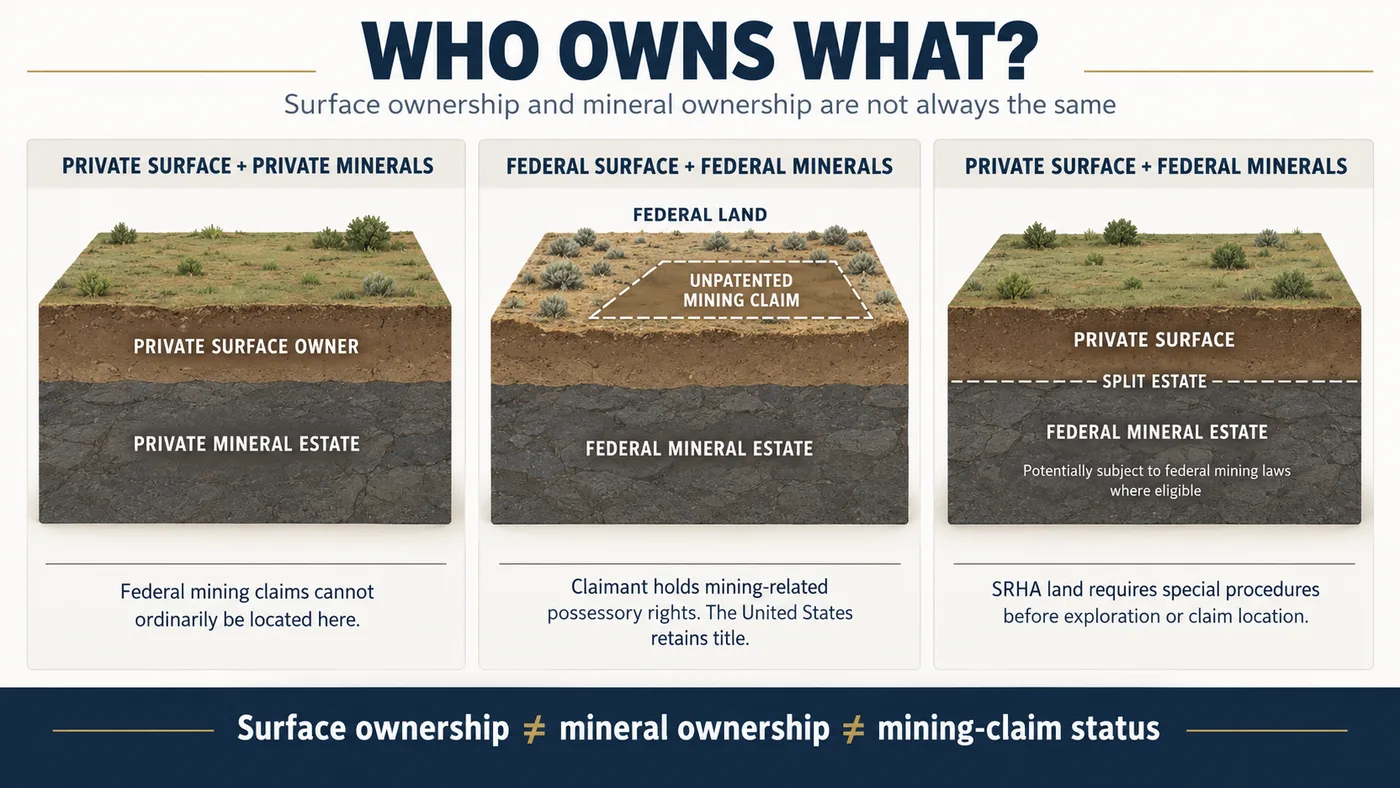
A Realistic Example: Private Ranch, Federal Minerals
Suppose a Montana ranch was originally patented under the Stock Raising Homestead Act.
The ranch family may own the private surface. They can use and transfer that property subject to applicable law.
But if the original patent reserved the minerals to the United States, owning the ranch does not automatically mean the family owns the federal mineral estate beneath it.
Could someone simply enter that private ranch and start staking hardrock mining claims?
No.
SRHA split-estate land has special federal procedures.
Before exploring for or locating a mining claim on qualifying SRHA land, the prospective locator must file a Notice of Intent to Locate, or NOITL, with BLM and notify the surface owner.
BLM requires a 30-day waiting period after that notification before exploration or location can begin, followed by a 90-day segregation period that runs from the day after BLM receives the completed NOITL. After that period, mining operations that go beyond minimal surface disturbance require either written consent from the surface owner or an approved BLM Plan of Operations.
So split estate does not mean the private surface owner owns the federal minerals.
But it also does not mean a prospector is free to walk onto private land and stake it without following the applicable procedures.
That distinction was missing from many simplified explanations of mining claims and mineral rights.
Locatable, Leasable and Salable Minerals
Another source of confusion is that not every federally owned mineral is acquired through a mining claim.
BLM generally divides federal minerals into three major systems.
Locatable minerals
These are the minerals associated with mining claims under the federal mining laws.
They include many metallic hardrock minerals such as:
Gold, silver, copper and lead, along with certain qualifying nonmetallic minerals.
Mining claims are located for locatable minerals, and a claim only holds up once there's an actual discovery, a real physical exposure of a valuable mineral deposit within the claim boundaries, not just a promising guess.
Leasable minerals
Minerals such as oil, gas and coal generally operate under federal leasing systems rather than the mining-claim system.
You do not stake an ordinary federal mining claim to acquire an oil deposit.
Salable mineral materials
Common varieties of materials such as sand, stone and gravel can fall under federal mineral-material sale rules.
Again, that is a different process from staking a mining claim.
This explains why someone researching a "mineral rights map" in an oil-and-gas area may be looking for completely different records than a gold prospector checking mining claims in Nevada.
Can You Stake a Mining Claim on Private Property?
Generally, no.
Ordinary privately owned land containing privately owned minerals is not open to location under the federal mining laws.
The owner of those mineral rights controls that mineral estate.
If you wanted to explore or develop privately owned minerals, you would normally need an agreement with the owner rather than a federal mining claim.
The major distinction is private surface over federally reserved minerals, including qualifying SRHA split-estate land.
Those federal minerals can potentially be subject to the mining laws, and land use is also governed by whether the area is open to mineral entry in the first place, but the special split-estate procedures described above still apply.
That is why looking at the color of the surface-management layer alone cannot tell you whether ground can legally be claimed.
Can You Buy an Existing Mining Claim?
Yes. An interest in an existing unpatented mining claim can be transferred.
But that does not mean the buyer is purchasing federal land.
The buyer is acquiring the seller's interest in the mining claim.
Transfer requirements involve the applicable state or local recording system as well as BLM. Current BLM guidance requires transfer documentation and a processing fee, and local recording requirements depend on the jurisdiction.
Anyone considering purchasing a claim should also independently verify the claim record, current status, location documents, maintenance history and what is actually being conveyed.
A listing that says "20 acres of land for sale" can create a very different impression from "interest in an unpatented federal mining claim."
Know which one you are buying.
How Do You Determine Who Owns the Minerals?
This is a title-research question, not simply a mining-map question.
A practical starting sequence is:
1. Identify the parcel and surface owner.
Start with the appropriate county property and deed records.
2. Read the actual deed.
Look for mineral reservations, exceptions or references to earlier deeds.
3. Follow the chain of title when necessary.
A mineral estate may have been severed decades before the current owner acquired the property.
4. Check the original federal patent when federal reservations may be involved.
The original patent can show whether the United States reserved minerals when the land left federal ownership.
5. Review appropriate BLM land-status records.
BLM Master Title Plats and related records can provide additional federal land-status information.
For a high-value property transaction or mineral-title dispute, professional title or legal assistance may be appropriate. Mineral ownership can become significantly more complicated than what appears on a modern parcel map.
How Do You Determine Whether a Mining Claim Already Exists?
That is a different research process.
BLM's Mineral & Land Records System, or MLRS, is the authoritative federal record for federal mining claims.
Before locating a claim, BLM advises prospectors to check its records for previously recorded claims. BLM also advises checking for existing claim markings on the ground.
Staked Maps helps with the research stage by placing recorded active and historical claim information alongside other useful map layers in a prospecting-focused interface.
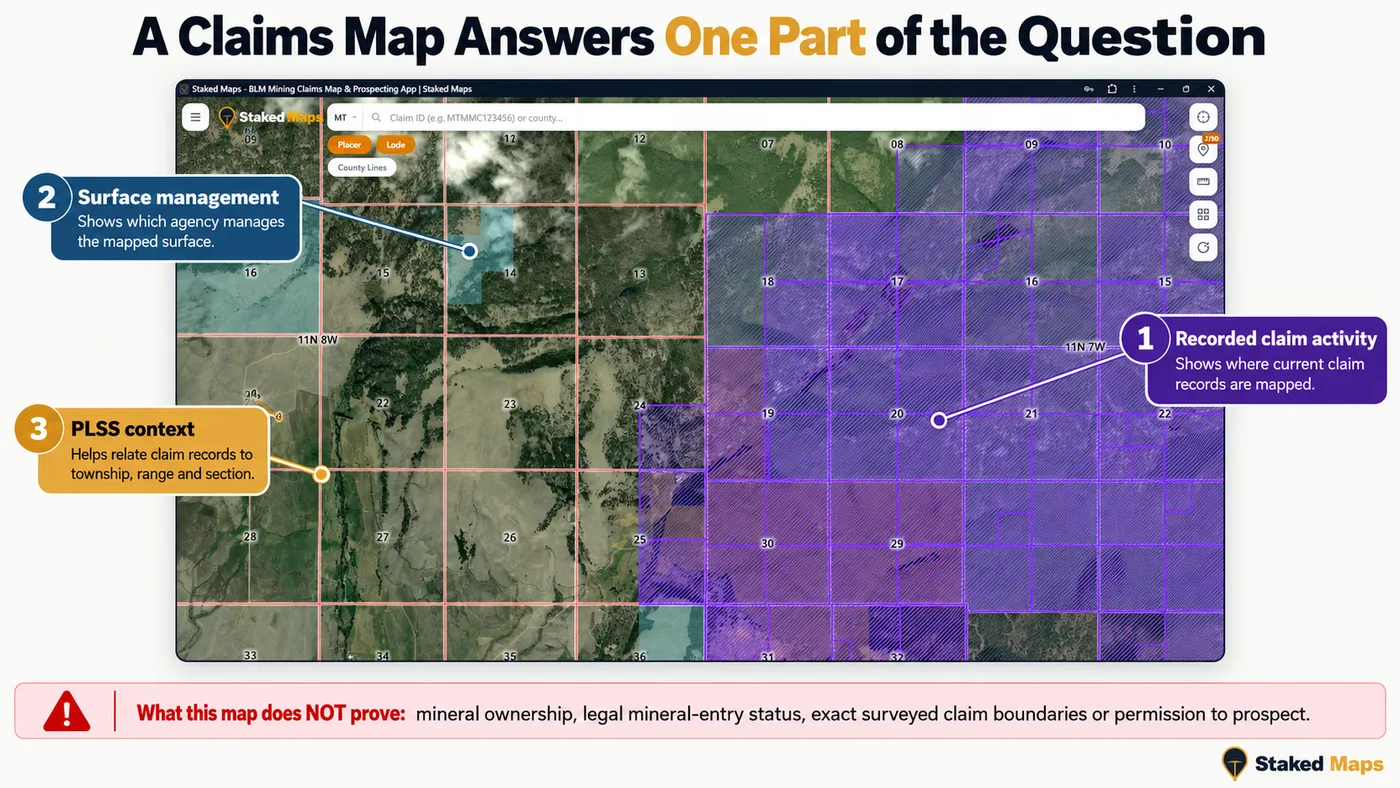
But there is an important limitation:
No mining claim on the map does not mean the land is automatically open to staking.
You still need to investigate questions such as:
- Does the United States own the relevant mineral estate?
- Is the land open to mineral entry?
- Has the area been withdrawn from mineral entry?
- Are there existing rights or restrictions that affect the ground?
- Is the mineral you're interested in actually locatable under the mining laws?
- Are there prior claim records or on-the-ground monuments that need investigation?
- What federal, state and local requirements apply?
BLM specifically identifies categories of land that are withdrawn or otherwise closed to mining-claim location.
A blank spot between claim polygons is therefore a research lead, not a legal determination that the acreage is open.
For a closer look at that research process, see how to check if a mining claim already exists.
Research Recorded Mining Claims in Staked Maps
Trying to determine whether mining claims are already recorded in the area you're researching? Staked Maps brings current BLM claim records, historical claims, surface-management information and other prospecting research layers together on one map. Use the map to narrow your research, then verify official records and field conditions before staking or prospecting.
See Claims in My State FreeNo credit card required.
Which Record Should You Actually Check?
Different records answer different questions.
| If you want to know... | Start your research with... |
|---|---|
| Who owns the surface? | County deed/property records and applicable land-management records |
| Who owns private mineral rights? | Deeds, mineral deeds, reservations and chain-of-title records |
| Did the United States reserve the minerals? | Original federal patent and appropriate BLM land-status records |
| Is a federal mining claim recorded here? | BLM MLRS, with tools such as Staked Maps useful for map-based preliminary research |
| Where is the claim shown in relation to PLSS and nearby recorded claims? | BLM records, local location documents and prospecting-focused mapping tools |
| Does an apparent claim-free area mean it is open to staking? | No. You must investigate mineral ownership, land status, withdrawals, existing rights and applicable regulations |
| Can I legally enter or mine the ground? | Applicable land-management agency, official records, state/local rules and field verification |
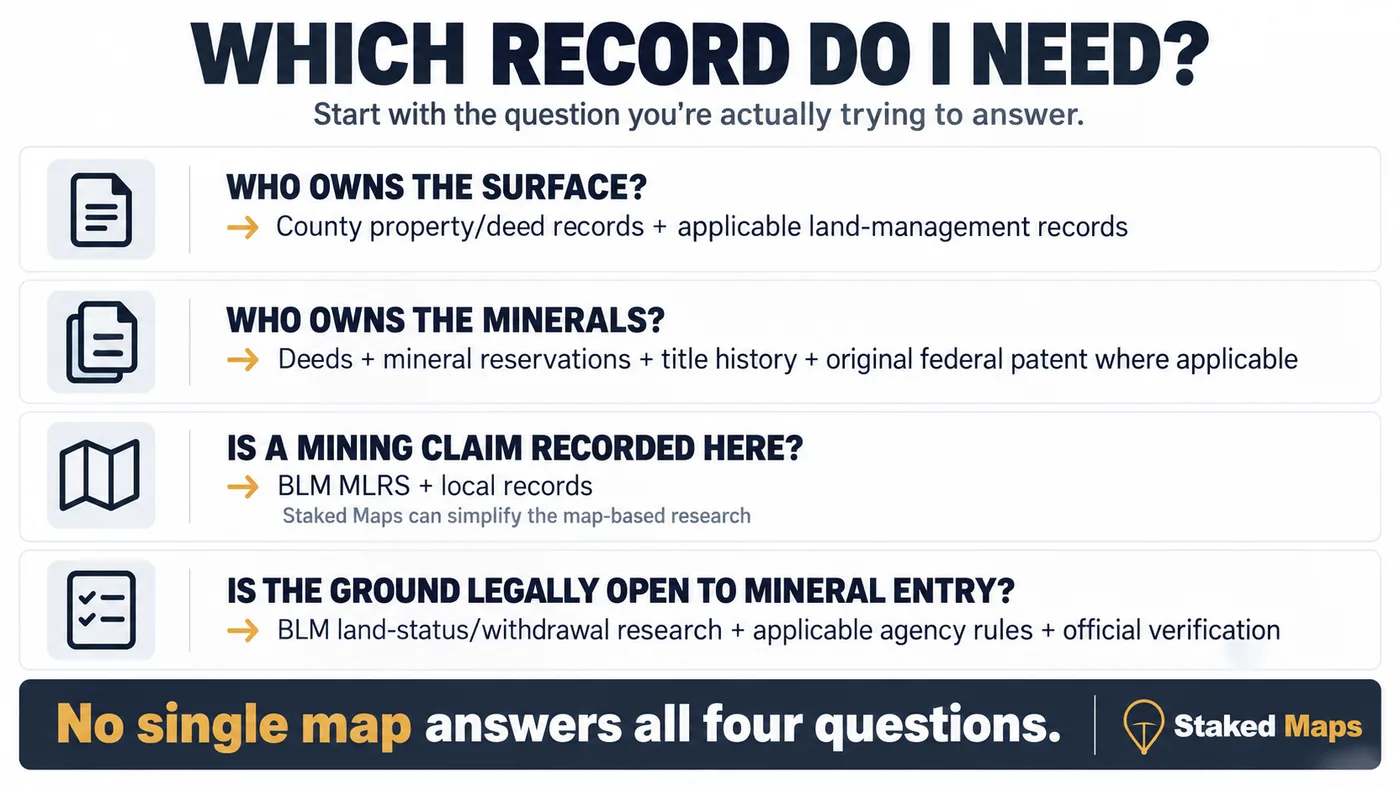
This is the key point:
Surface ownership, mineral ownership, mining-claim status and legal mineral entry are four related but separate questions.
Treating them as one question is how costly mistakes happen.
What a Mining Claim Does Not Automatically Give You
Holding a mining claim does not automatically give you:
Private ownership of the federal land.
A homesite or recreational cabin site.
Authority to block every lawful public use of the surface.
Permission to ignore environmental or land-management requirements.
A guarantee that every part of the mapped claim contains a valuable mineral deposit.
A survey-grade GPS boundary.
Or unlimited authority to disturb the surface.
A claim is a mining right, not a general-purpose private parcel. For more on what claim rights do and don't cover, see can you build a cabin on your mining claim?
Common Mineral Rights and Mining Claim Myths
Myth: If I own the land, I own the minerals.
Not necessarily.
Surface and mineral estates can be severed. The deed history and original patent may contain mineral reservations that are not obvious from a modern property map.
Myth: If a mining claim is shown on federal land, the claimant owns that land.
Not in the case of an ordinary unpatented federal mining claim.
The federal government retains title while the claimant holds mining-related possessory rights.
Myth: If no active claim appears on the map, I can stake it.
No.
An absence of recorded active claims answers only one part of the research question. Mineral ownership, withdrawals, land status and other restrictions still matter.
Myth: Private land can never have federal minerals underneath it.
False.
Split-estate land can have private surface ownership and federally reserved minerals. SRHA lands are one important Western example.
Myth: A mining claim and patented mining property are basically the same.
No.
A patented mining claim received federal title and became private property. An unpatented claim does not transfer federal title.
Myth: Paying the annual fee makes a claim valid forever.
No.
Annual maintenance keeps a claim from being forfeited for failure to meet that particular maintenance requirement, but it does not by itself establish every element necessary for claim validity.
Most claimants pay an annual maintenance fee, generally due on or before September 1. Qualifying small miners who hold 10 or fewer claims/sites nationwide may instead use the maintenance-fee waiver process and perform the required assessment work. For the full picture of what keeps a claim alive year to year, see how long a mining claim actually lasts.
The Bottom Line
Mineral rights and mining claims can overlap geographically, but legally they answer very different questions.
Mineral rights answer: Who owns the mineral estate?
Mining-claim records answer: Who has asserted mining rights on qualifying federal mineral estate?
Surface records answer: Who owns or manages the ground above it?
Land-status and withdrawal research helps answer: Is this federal mineral estate actually open to mineral entry?
If you're researching private mineral ownership, start with the title records.
If you're researching federal mining claims, start with current BLM records.
And if you're trying to understand a specific piece of ground, don't rely on any one map layer to answer all four questions.
This guide was checked against current BLM guidance on mining claims, mineral rights, split estate and mineral patents as of September 17, 2026. Staked Maps is a research and navigation tool, not a title report, legal opinion or determination that land is open to mineral entry. Verify official records, current regulations and field conditions before relying on mining-claim or land-status information.