

Yes, you can generally keep small amounts of gold you legally pan from BLM land for personal use. The catch is that not every piece of BLM land is open to prospecting, and public land is not the same thing as unclaimed land.
Before heading for the creek, you need to know three things: who manages the land, whether the minerals are open to prospecting, and whether someone already holds a mining claim there. Those details matter more than most beginners realize.
Recreational gold panning doesn't have to be complicated, though. Once you know what to check, you can spend less time worrying about the rules and more time looking for color.
Can You Legally Keep Gold Found on BLM Land?
In many cases, yes.
The Bureau of Land Management (BLM) treats traditional hand panning as "casual use" on public lands that are open to mineral entry. Under 43 CFR 3809.5, casual use means activities "ordinarily resulting in no or negligible disturbance of the public lands or resources," and the regulation lists hand panning and non-motorized sluicing as typical examples. Casual use doesn't require a notice or plan of operations.
You typically don't need to stake a mining claim or file anything with BLM just to work a pan on land that's open to recreational prospecting.
There are limits. BLM's Can I Keep This? guidance says you may collect reasonable amounts of rocks and mineral specimens, including gold, silver and other precious metals, for "personal use or enjoyment (not for sale or barter)." That guidance doesn't let you extract minerals anywhere you want, and it doesn't authorize commercial production.
Most importantly, you cannot walk onto someone else's active mining claim and collect gold without the claimant's permission. BLM's guidance says so directly.
The ground might look untouched, with no signs, fences or equipment in sight. That still doesn't mean it's available, which is why a little research before your trip can save you a lot of trouble.
Public Land Doesn't Always Mean Open Ground
This is probably the most important thing to understand about recreational gold prospecting.
BLM manages millions of acres across the western United States. Some of that land is open to mineral entry and recreational prospecting. Other parcels carry withdrawals, existing mining claims, special designations or other limits, and the rules can change from one stretch of creek to the next within the same drainage.
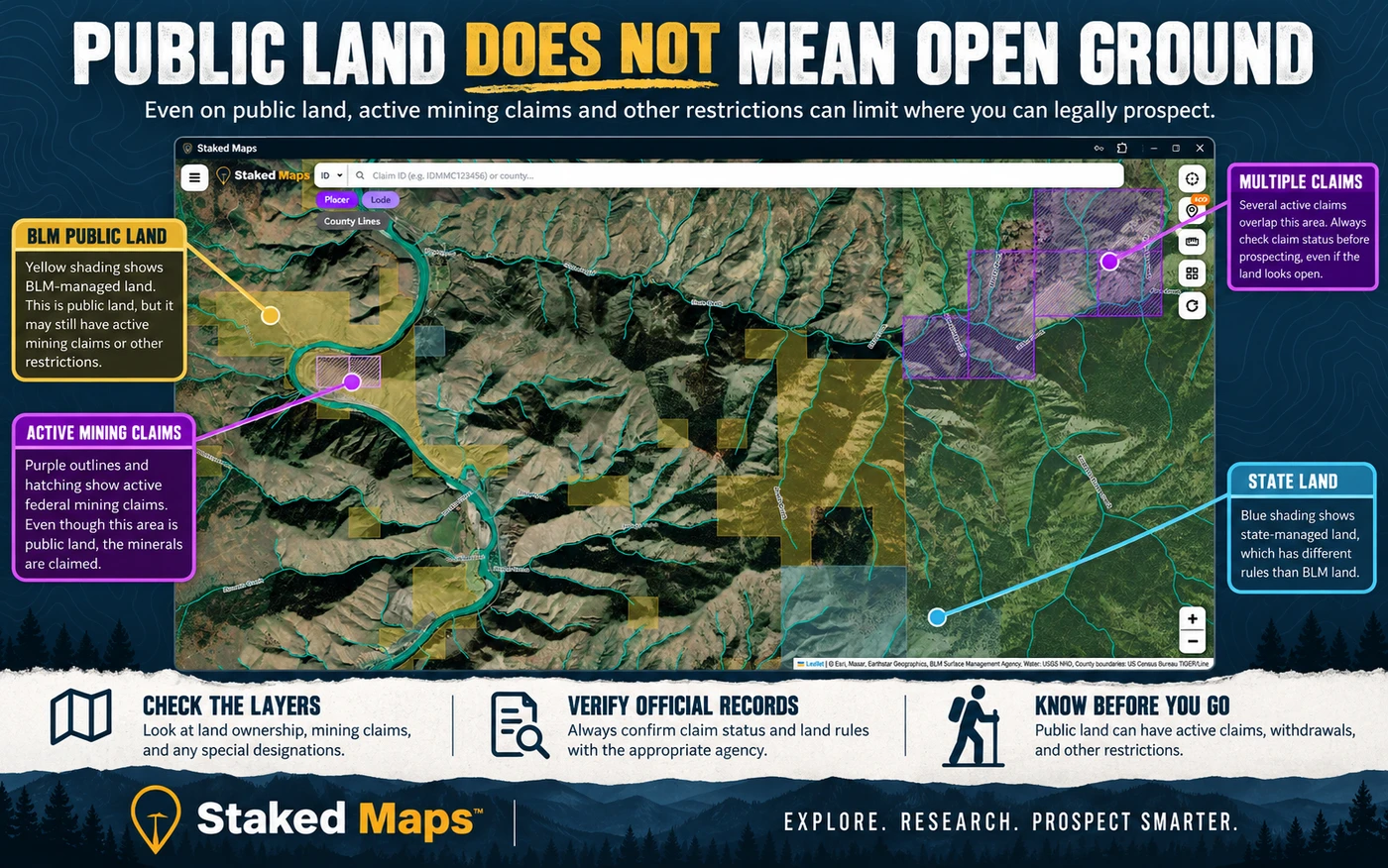
Here are five things worth checking before you put a pan in the water.
1. Who Actually Manages the Land?
Start with land ownership and management. BLM land, National Forest land, state trust land, private property and National Park Service land all have different rules. National parks, for example, generally prohibit mineral collecting.
Don't assume an area is BLM land because it looks like open desert or undeveloped mountain country. Our guide on how to tell if land is BLM land walks through how to check.
Surface ownership and mineral ownership aren't always the same, either. In some places the federal government owns the minerals while someone else owns the surface, and the surface owner's permission still matters.
A public land map tells you where to start looking. It doesn't give you permission to prospect.
2. Are the Minerals Open to Prospecting?
Even when BLM manages the surface, the minerals may be withdrawn from location under the federal mining laws. Withdrawals protect land for conservation, recreation, infrastructure and other public purposes.
A withdrawal doesn't automatically ban every kind of recreational collecting, but it does mean ordinary mining law access no longer applies by default. You need to look at the specific rules for that withdrawal. The local BLM field office can tell you the status of a particular area.
3. Is There an Existing Mining Claim?
This is the one that catches people off guard.
An active mining claim gives the claimant rights to the locatable minerals within it, even though the surface stays federally managed public land. You may be free to hike, camp or fish there without having any right to remove gold.
Never assume a claim is inactive because nobody seems to be working it. Claim markers can be hard to find, and many have deteriorated or disappeared. An old-looking mine site tells you nothing about whether the current claim is valid.
Check the claim records before you go. Our walkthrough on how to find out if a mining claim exists covers the records step by step. If the area is actively claimed, get the claimant's permission before prospecting there.
4. Are There Special Restrictions?
Some public lands carry extra protection because of their natural, cultural, historical or recreational value. These include wilderness areas, wilderness study areas, national monuments, national conservation areas and Areas of Critical Environmental Concern (ACECs).
A special designation doesn't automatically ban gold panning. The rules depend on the area's management plan, any withdrawals and the activity you have in mind. BLM's own guidance, for example, says only non-motorized hand tools may be used for collecting in wilderness areas, so a pan may be fine where a motorized drywasher is not. Other places, such as developed campgrounds and picnic sites, prohibit mineral collecting entirely.
Check the rules for the specific place you plan to visit.
5. Do State Rules Add More Restrictions?
Federal permission is only part of the picture. States regulate activities that affect waterways, fish habitat, water quality and mining equipment. A method that qualifies as casual use under BLM rules may still need a state permit, or be banned under state law.
Ordinary hand panning is far simpler than running a suction dredge, but local restrictions can still apply. We cover Oregon and California in detail below.
How to Check a Gold Panning Location Before You Go
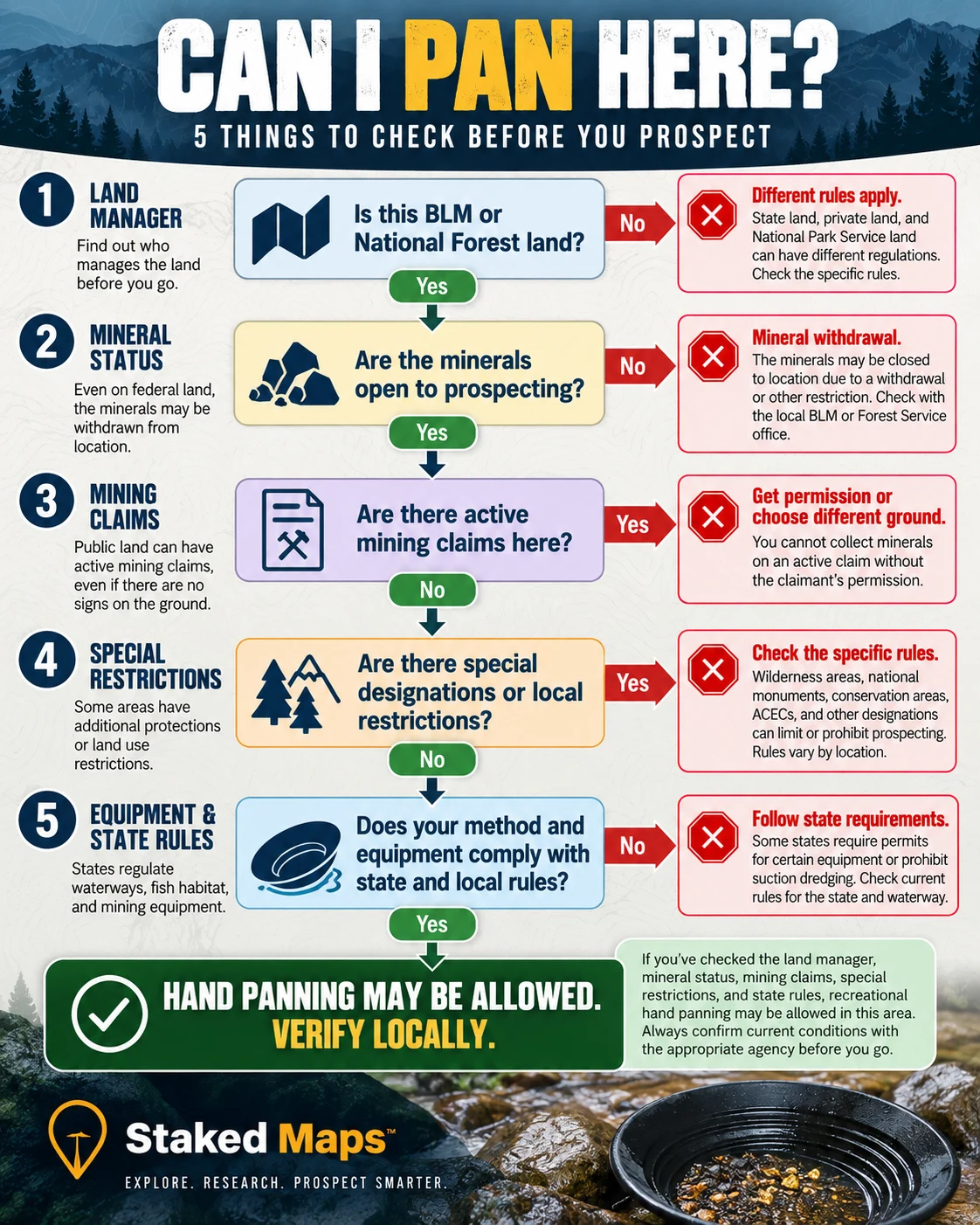
Finding a promising creek is one thing. Finding a promising creek where you can legally prospect is another. Here's a practical way to research a spot before making the drive.
Step 1: Identify the land manager. Determine whether the area is BLM land, National Forest, state land or private property. If ownership is mixed or unclear, keep digging before you go in.
Step 2: Look for active mining claims. Check the area for recorded federal mining claims, especially claims covering the creek, its banks or the ground you plan to work.
Step 3: Check land status and restrictions. Look for mineral withdrawals, special management designations, recreation closures and anything else that could affect prospecting.
Step 4: Verify the records. Confirm current claim and land status with BLM's Mineral & Land Records System (MLRS) and the local field office. Mining claim maps are research tools, not legal surveys. A claim boundary drawn on a map should never be treated as a surveyed property line.
Step 5: Check your equipment against state rules. Before using a sluice, rocker box, dredge, pump or other equipment, confirm what the state and the managing agency allow.
If you're unsure about a location, ask the managing agency before you prospect.
Where Staked Maps Fits In
Researching a location usually means jumping between land management maps, claim records and other government sources. Staked Maps brings that information together on one map.
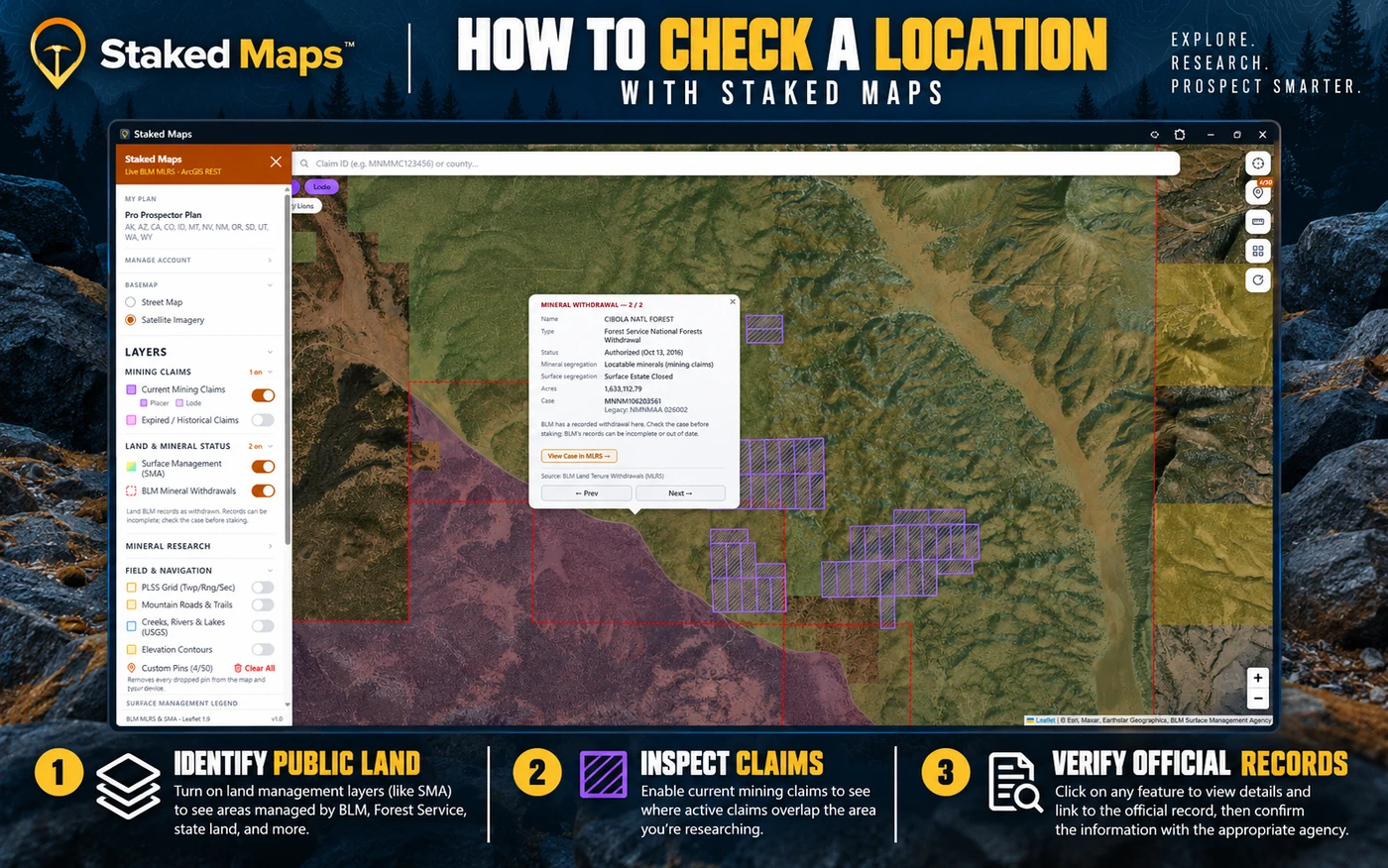
You can view current federal mining claims alongside surface management and other land status layers, narrow down the areas worth researching, and spot potential conflicts before heading into the field. It's especially useful when you're comparing several creeks or trying to see how claims overlap public land.
Check Mining Claims on the Staked Maps Map
Staked Maps is a research and planning tool. Claim data and mapped boundaries should be checked against current official records, and an area with no displayed claim is not automatically open to prospecting.
What Does BLM Casual Use Actually Allow?
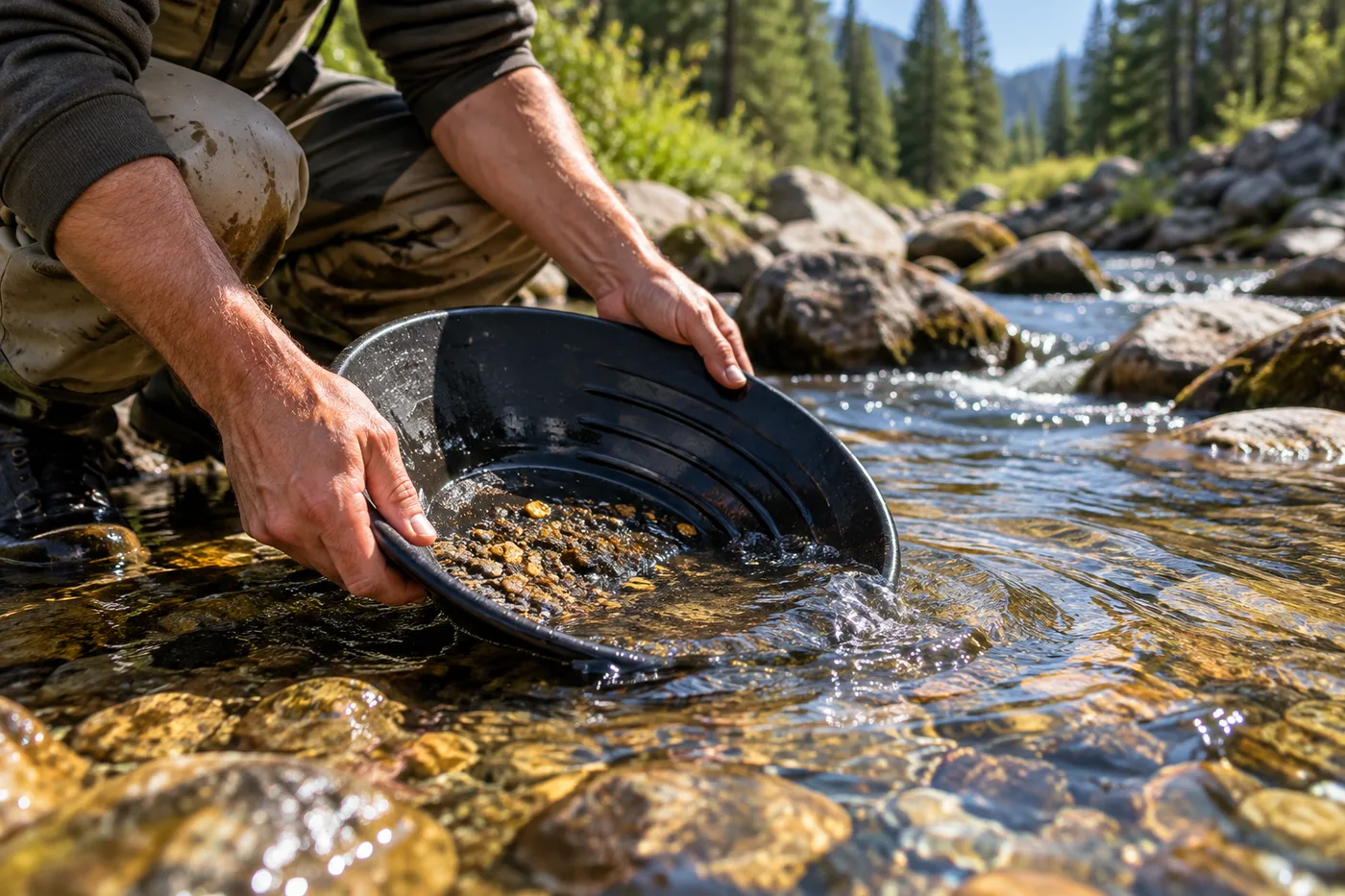
Under 43 CFR 3809.5, casual use covers activities that cause no more than negligible disturbance to public lands and resources. Traditional gold panning is the classic example. A person with a pan, a small shovel and ordinary hand tools will usually qualify where prospecting is otherwise allowed.
The regulation says casual use "generally includes" hand panning, non-motorized sluicing, metal detectors and hand or battery-operated drywashers, and "may include" small portable suction dredges. It excludes mechanized earthmoving equipment, truck-mounted drilling equipment, chemicals and explosives. What matters is the amount of disturbance, not whether you call the activity recreational.
| Activity | General considerations |
|---|---|
| Hand panning | Low disturbance; listed in 43 CFR 3809.5 as casual use |
| Hand digging with small tools | Can qualify if disturbance stays negligible |
| Non-motorized sluicing | Listed as casual use federally; state water rules may still apply |
| Highbanking | Pumps, water discharge and disturbance can trigger state and federal requirements |
| Suction dredging | Banned in California; permit-based in Oregon; can need federal authorization beyond casual use |
| Mechanized excavation | Excluded from casual use; requires a notice or plan of operations |
This is a general guide, not a nationwide equipment permission chart. BLM's surface management rules separate casual use from operations that need a notice or a plan of operations, and separate rules can apply to waterways and protected areas.
A small piece of equipment isn't automatically legal because it's portable. And a motorized operation doesn't become casual use because you only run it on weekends.
Can You Pan for Gold on an Active Mining Claim?
Not without the claimant's permission.
An active federal mining claim gives the claimant legally recognized mineral rights, subject to applicable law. The fact that the claim sits on public land doesn't give everyone else the right to collect its minerals.
This matters most along popular gold-bearing creeks, where claims can sit side by side for long distances. You might find what looks like an open stretch between two old workings, only to discover it falls inside an active claim.
Check the official records and resolve any doubt about a claim's location before you prospect. Don't rely on physical claim markers, since their absence doesn't prove the ground is unclaimed.
What About Closed Mining Claims?
A closed claim record doesn't mean the ground is available. The same area could be covered by a newer active claim, sit inside a withdrawal, be privately owned or carry other restrictions. Claim status is only one part of deciding whether prospecting is legal.
Unclaimed does not automatically mean open. Keep that in mind whenever you research a new location.
Can You Pan for Gold in National Forests?
Often, yes, with the same precautions.
Many National Forest lands are open to prospecting under the federal mining laws. Forest Service regulations at 36 CFR 228.4 say a notice of intent generally isn't required for prospecting that won't significantly disturb surface resources, and they list "gold panning, metal detecting, non-motorized hand sluicing" and battery-operated drywashers as examples.
National Forests can still contain active mining claims, withdrawn lands, designated wilderness and protected streams. If you're planning anything beyond simple hand panning, contact the ranger district to find out whether you need a notice of intent, a plan of operations or another authorization. The Forest Service's locatable minerals program page is a good starting point.
As on BLM land, public access doesn't equal permission to remove minerals.
Oregon Gold Panning Rules
Oregon has a long placer mining history, especially in the southwest and northeast parts of the state. Hand panning remains a popular way to explore it, and Oregon's water rules sort equipment into clear tiers. (For claim activity and land status across the state, see our Oregon mining claims map.)
Hand panning. Oregon DEQ's 700-PM general permit, renewed effective May 23, 2025, does not apply to simple hand panning. DEQ's permit fact sheet states that "hand panning is not considered to be a point source and is exempt from permitting requirements."
Non-motorized in-stream equipment. Hand sluices, rocker boxes and hand suction devices are covered by the 700-PM permit. You don't have to register, but DEQ requires you to keep a copy of the permit on hand and follow its conditions for non-motorized equipment.
Suction dredges. Motorized and gravity or siphon suction dredges require registration under the 700-PM permit, and dredging is limited to daylight hours during the Oregon Department of Fish and Wildlife in-water work period. Gravity and siphon dredge hoses are capped at six inches outside Essential Salmon Habitat and four inches inside it.
Essential Salmon Habitat (ESH). Oregon law (Senate Bill 3, 2017) prohibits motorized in-stream placer mining up to the ordinary high water line in rivers containing essential salmon habitat. The Oregon Department of State Lands also requires a removal-fill authorization to move any amount of material in ESH streams and State Scenic Waterways, and says a permit is required for non-motorized placer mining in ESH streams. If you plan to dig in the bed of an ESH stream, even with hand tools, check with DSL first.
None of this means every creek is open. You still need to check claims, land status, access and any closures for the stream you plan to work.
California Gold Panning Rules
California has plenty of recreational gold panning opportunities, but its equipment restrictions deserve close attention. (See our California mining claims map for claim activity across the state.)
Traditional hand panning is allowed on appropriate public lands where mineral collecting is permitted and no existing claim prevents it. The California Department of Fish and Wildlife states that suction dredging "is currently prohibited and unlawful throughout California," and that its definition of suction dredging, the use of a mechanized or motorized system to remove material from a river, stream or lake, does not restrict nonmotorized recreational mining activities, including panning for gold. CDFW continued citing illegal dredging operations in 2026.
Don't assume equipment that's legal in another western state can be used in California. Also check local rules, especially in state parks, protected areas and waterways with special restrictions.
How Much Gold Can You Keep?
There's no single nationwide rule that gives recreational prospectors a set number of ounces from BLM land. BLM's guidance refers to reasonable amounts for personal use or enjoyment, and what's allowed depends on land status, the applicable regulations and the nature of your activity.
For a hobbyist pulling a few flakes or small pickers from a pan, the amount is rarely the real question. What matters more is whether collecting was allowed there in the first place.
If you plan to extract substantial quantities or run an ongoing operation, the rules for casual recreational panning probably don't cover what you're doing. Contact the BLM field office to find out which mining laws and authorizations apply.
Can You Sell Gold You Pan on BLM Land?
This is where recreational collecting and commercial mineral production part ways.
BLM's recreational collecting guidance covers reasonable amounts collected for personal use or enjoyment, "not for sale or barter." The federal mining laws do provide a path for legitimate mineral exploration and production, usually through a mining claim, but that path comes with its own legal requirements.
Hand panning that qualifies as casual use under the surface management rules does not, by itself, give you open-ended permission to collect gold for commercial sale. If you want to recover gold specifically to sell it, confirm the applicable mineral rights and requirements with the managing BLM office first.
Do You Owe Taxes on Gold You Find?
Selling recovered gold can have tax consequences. How the money is treated depends on your circumstances, including whether prospecting is a hobby, a business or part of a larger mining operation.
You may have seen claims that panned gold is taxable at market value the moment you find it, based on the IRS "found property" rule. That rule, in IRS Publication 525, covers property "that doesn't belong to you that has been lost or abandoned (treasure trove)," like cash found inside a used piano. Naturally occurring gold in a creek isn't lost property, and the IRS doesn't publish a rule that treats each flake as income the moment it lands in your pan.
If you sell gold regularly or recover significant quantities, talk to a tax professional who understands mineral income.
Common Questions About Gold Panning on BLM Land
Do I need a permit to pan for gold on BLM land?
Ordinary hand panning is listed as casual use under 43 CFR 3809.5 and doesn't require a federal notice or plan of operations. The land still has to be open to the activity, and state or local rules may apply.
Can I keep gold I find on public land?
Generally yes, when recreational collecting is allowed and the gold is recovered legally. BLM's guidance allows reasonable amounts for personal use in appropriate areas. Public ownership alone doesn't guarantee collecting rights.
Can I pan for gold anywhere on BLM land?
No. Existing mining claims, mineral withdrawals, special designations, closures and state rules can limit or prohibit prospecting.
Is gold panning allowed on unclaimed BLM land?
It may be, but the absence of an active mining claim isn't enough. You also need to confirm the minerals are open to prospecting and that no other restriction applies.
Can I pan on someone else's mining claim?
Only with the claimant's permission. Public access to the surface doesn't include the right to collect the claimed minerals.
Do I need to stake a mining claim to pan for gold?
Not for low-impact recreational hand panning on open land. More extensive exploration or production involves different requirements.
Is gold panning legal in wilderness areas?
It depends on the area. BLM's guidance says only non-motorized hand tools may be used for collecting in wilderness, and some areas carry further restrictions. Check with the managing agency.
Can I use a sluice box on BLM land?
Possibly. Federal rules list non-motorized sluicing as casual use, but state water rules can still apply. In Oregon, for example, hand sluices are covered by DEQ's 700-PM permit, which means keeping a copy of the permit on hand and following its conditions.
How do I know whether a creek has an active mining claim?
Start with a mining claim map, then confirm with BLM's MLRS records. Check the land descriptions and confirm any uncertain boundaries or status with the BLM state or field office.
Before You Head for the Creek
There's something satisfying about pulling a few flakes of gold from a creek with nothing more than a pan and some patience. The best place to start, though, is finding out whether you're allowed to work it.
Check who manages the land. Look for active mining claims. Confirm the minerals are open to prospecting. Make sure your equipment meets the rules for that particular stream.
A little preparation can save you an unpleasant run-in with a claim holder, a wasted trip or a violation you didn't know you were committing.
Research Your Next Creek Before You Drive Out
Staked Maps puts current BLM mining claims, surface management and other land status layers on one map, so you can narrow down where to look and know which records to verify before you head out.
See Claims in My State FreeNo credit card required.
Staked Maps provides mapping and research information, not legal permission to prospect. Always verify current land status, mining claims and applicable rules with the appropriate government agencies.
Official Sources and Further Reading
- BLM: Can I Keep This? Recreational Collecting
- BLM: Mineral & Land Records System (MLRS)
- BLM: Surface Management Handbook H-3809-1
- 43 CFR Subpart 3809: Surface Management
- 36 CFR 228.4: Forest Service Notice of Intent and Plan of Operations
- U.S. Forest Service: Locatable Minerals
- Oregon DEQ: Mining and the 700-PM Permit
- Oregon DEQ: 700-PM Permit Renewal Fact Sheet
- Oregon Department of State Lands: Removal-Fill Permits
- California Department of Fish and Wildlife: Suction Dredge Permits
- IRS Publication 525: Taxable and Nontaxable Income
Regulatory information reviewed: October 8, 2026. Regulations and local closures change. Check current agency guidance before prospecting.